From Classroom to Barracks; The Militarization and Ideological Mobilization of Children
“Under the Paris Principles (2007), a child soldier is not limited to a child carrying weapons. Any person under the age of 18 recruited or used by armed forces or affiliated structures for guarding, checkpoints, support, surveillance, or security-related activities falls within this definition.”

The International Day of Innocent Children Victims of Aggression, observed annually on June 4, is commonly associated with children killed, displaced, or traumatized by war. In Iran, however, another alarming process has increasingly emerged: the systematic ideological and security-oriented mobilization of children and teenagers by state institutions.
Over the past several years, the ruling regime in Iran has expanded structures aimed not only at indoctrinating children ideologically, but also at preparing a new generation for future roles within surveillance, repression, and internal security systems. Student Basij networks, militarized educational programs, “Police High Schools,” ideological supervision inside schools, cyber-war training, and even propaganda cartoons centered on missiles and drones collectively point to a broader institutional project: the militarization of childhood.
“From Minefields to Checkpoints”
The use of children in military and security structures in Iran is not new.
During the Iran-Iraq war, numerous reports documented the use of teenagers in dangerous military operations, including minefield clearing missions.
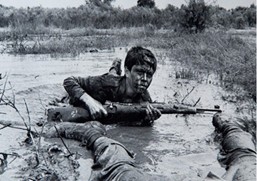 On May 1, 1983, the newspaper Ettelaat described such scenes: “15-year-olds, 14-year-olds… joyful and chanting prayers… dawn and minefields… moments later, when the dust settled, nothing remained except pieces of flesh and bone scattered across the desert.”
Iranian officials later acknowledged the scale of student casualties during the war. Mojtaba Jafari stated that: “More than 33,000 students” were killed during the conflict.
In later years, allegations also emerged regarding the recruitment of minors linked to Iran-backed forces in the Syrian conflict. On October 18, 2018, then-U.S. Ambassador to the United Nations Nikki Haley stated before the Security Council: “The IRGC recruits’ children and trains them to fight in Syria in support of the Assad regime.”
Recent developments suggest that this historical pattern has evolved from wartime mobilization into domestic security deployment through checkpoints, patrols, and ideological-security networks inside Iran itself.
“A Revolutionary Generation”
In October 2024, Ali Khamenei declared: “The new generation must be trained for presence in difficult security and defense arenas.”
The statement reflected a broader policy increasingly visible across Iran’s educational and security institutions.
In November 2025, Education Minister Alireza Kazemi described schools as: “The main branches for training officers of the soft war.”
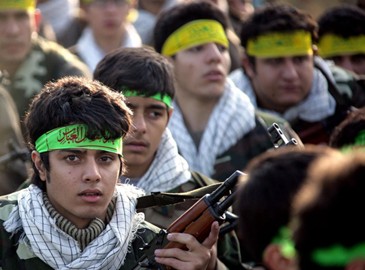 The concept of “soft war officers” has become a recurring term in state educational discourse. Students are increasingly portrayed not as independent learners, but as ideological defenders expected to confront perceived cultural, political, and media “threats.”
State-affiliated educational programs now repeatedly emphasize:
- “Jihad of Clarification,”
- ideological vigilance,
- cyber warfare,
- and “revolutionary identity-building.”
“35,000 Student Basij Units”
The head of Iran’s Student Basij Organization announced in 2024 that: “35,000 Student Basij units are active in schools across the country.”
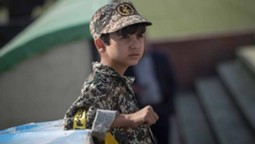 This structure represents one of the regime’s largest youth mobilization networks. Student Basij units operate not only inside schools, but also in ideological camps, cyber initiatives, state ceremonies, neighborhood security programs, and “Jihad of Clarification” campaigns.
State media have described these programs as part of a nationwide effort to build:
- “Revolutionary youth,”
- “Committed generations,”
- and future ideological cadres.
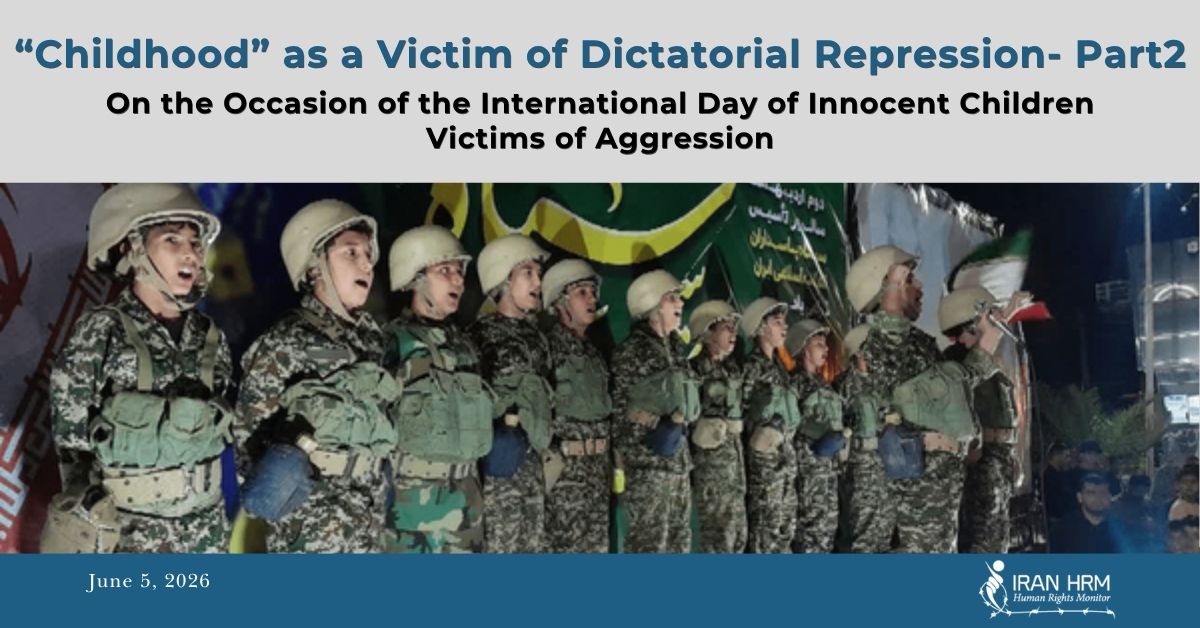
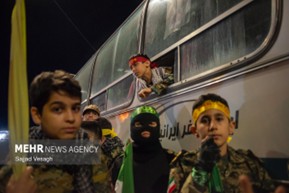
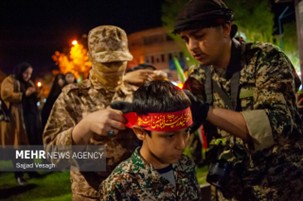
Images released by Basij-linked outlets frequently depict teenagers in military-style uniforms, carrying security gear, participating in drills, and attending indoctrination programs linked to the IRGC and Basij.
“From School to Barracks”
One of the clearest manifestations of the militarization of education emerged in February 2026, when Mehr News Agency quoted Saeed Montazerolmahdi, Deputy for Cultural and Social Affairs of Iran’s Law Enforcement Command (FARAJA), announcing: “The country’s first Police High School will begin educational activities in October 2026.”
He explained that these schools were intended for: “Training the future generation and committed forces.”
One week later, Iran’s police chief Ahmadreza Radan announced the expansion of Police High Schools to Tehran and six additional provinces. He openly stated that the schools were designed to train: “Revolutionary, Velayat-oriented, jihadi, committed, and specialized forces.”
Radan further described the schools as: “a new pathway for teenagers and youth interested in entering the police organization.”
The institutions are planned as fully residential boarding schools. In May 2026, Mohammad Hossein Hamidi, Deputy for Training and Education of FARAJA, stated: “Police High Schools will operate as boarding schools.”
He added: “This is a serious step toward training the future commanders of FARAJA and police cadre-building.”
Official reports state that these schools will contain:
- artificial intelligence laboratories,
- specialized workshops,
- dormitories,
- martial arts facilities,
- swimming pools,
- sports complexes,
- and advanced training infrastructure.
Critics argue that the project represents a new stage in the institutional integration of education and repression.
“Free Education for Future Repressors”
The regime’s investment in Police High Schools sharply contrasts with the broader collapse of public education in Iran.
While between 900,000 and 2 million children are estimated to be out of school:
- 48 percent of child laborers have dropped out,
- Many children in Sistan and Baluchestan study in unsafe mud structures,
- and thousands of girls leave school due to child marriage,
Iranian authorities repeatedly emphasized that Police High Schools would provide entirely “free” education.
One analysis described this policy as: “a systematic exploitation of poverty to transform the victimized child into a future agent of repression.”
The same analysis warned that the regime is using “luxury free education” as bait to recruit children from low-income families into future security structures.
“The Amin Plan”
Alongside militarized schooling, ideological monitoring inside schools has expanded significantly.
Under the regime’s “Amin Plan,” approximately 10,000 seminary clerics have reportedly been deployed inside schools to supervise and ideologically guide students.
 The project forms part of the regime’s broader “Fundamental Transformation Document,” which replaced elements associated with UNESCO’s 2030 educational framework.
One analysis warned: “Schools are being transformed from places of scientific development into educational barracks.”
The same report described Police High Schools as: “The operational and strike arm of this Transformation Document.”
“Shad platform”
The regime’s “Shad” platform, originally introduced as an online education application, has evolved into a broader mechanism of information control and ideological management.
On December 14, 2025, Ali Bagherzadeh, advisor to the Minister of Education and head of the Human Resources Center of the Shad Steering Council, stated: “Shad is not merely a video education service, but a complete educational, ideological-training, and cultural ecosystem.”
He further stated: “Access to words, websites, and environments considered inappropriate is effectively blocked for student users.”
The statement openly confirms that Shad functions not merely as an educational platform, but as a controlled digital environment designed to filter and direct information accessible to children and teenagers.
Analysts have linked this process to broader efforts toward “digital isolation” and systematic ideological conditioning of younger generations.
“Missiles for Children”
One of the clearest examples of militarized propaganda targeting minors emerged through the animated series “Havagardan,” distributed through the Shad platform.
 On May 4, 2026, Daneshjoo News Agency reported that the series received: “Widespread enthusiastic reception among students,” with more than 40,000 simultaneous student viewers during one broadcast.
Tasnim News Agency explained that the animation was specifically created to: “Familiarize teenagers with the defensive capabilities of the Islamic Republic of Iran.”
The series introduces Iranian missiles and drones through humor, cartoon storytelling, and child-oriented character design. Tasnim described this approach as a “creative” method for creating emotional connections between teenagers and military technologies.
Critics argue that using humor and animation to normalize missiles and drones among children amounts to the promotion of militarization and violence among minors.
This process occurs while Iranian officials themselves acknowledge a growing mental health crisis among children. In April 2026, Seyed Hassan Mousavi Chelak, Deputy for Social Health at Iran’s Welfare Organization, announced that:
- 899,793 children aged 5–6 had undergone anxiety screening,
- and 186,772 were identified as potentially suffering from anxiety disorders.
He warned that untreated childhood anxiety could later lead to depression, addiction, personality disorders, and chronic psychological harm.
“A Child at a Checkpoint”
On March 10, 2026, 11-year-old Alireza Jafari, a fifth-grade student, was killed during a drone strike targeting a checkpoint on Tehran’s Artesh Highway.
Basij-affiliated organizations, including the Teachers Basij Organization, officially confirmed that he had been present at the checkpoint: “While performing duty.”
According to Hamshahri newspaper, Alireza’s mother stated that his father had taken him to the checkpoint because of: “Lack of personnel.”
The incident occurred only days after Rahim Nadali, Deputy for Cultural Affairs of Tehran’s IRGC, publicly announced on state television: “We lowered the age to 12… now 12- and 13-year-old kids want to be present in this environment.”
The statement strongly suggests that the presence of minors in checkpoints and security operations is not an isolated incident, but part of a broader policy trend normalizing the participation of children in security environments.
Under international child protection standards, placing minors in operational, surveillance, or security-support environments may itself constitute a violation of children’s rights and fall within broader frameworks associated with child militarization.
Legal Framework
Iran is a state party to the Convention on the Rights of the Child (CRC). Article 29 states that education must be promoted:
- peace,
- tolerance,
- human dignity,
- and friendships among peoples.
Article 38 obliges states to protect children from involvement in armed conflict and related military activities.
The Optional Protocol on the Involvement of Children in Armed Conflict (OPAC) expanded international concern beyond direct battlefield participation and emphasized broader forms of military exploitation and recruitment of minors.
The Rome Statute of the International Criminal Court defines the use of children under 15 in armed conflict as a war crime.
Although the current situation in Iran does not fit the framework of a conventional armed conflict, the use of minors in security, surveillance, checkpoint, and quasi-military structures raises serious concerns regarding violations of international child protection standards and potential individual criminal responsibility.
Final Analysis
The growing use of children and teenagers in ideological, security, and quasi-military structures reflects more than isolated incidents or symbolic propaganda. It reveals a broader strategy of preemptive social control and long-term security cadre-building.
Following the nationwide protests of recent years, Iranian authorities increasingly expanded checkpoint systems, neighborhood surveillance structures, Basij patrols, and ideological youth mobilization networks. Within this framework, minors are not merely passive recipients of propaganda; they are gradually integrated into monitoring, security, and loyalty-enforcement structures.
Ahmad Alamolhoda, Friday Prayer Imam of Mashhad, openly urged Basij supporters: “Preserve your Hezbollah identity in the streets… preserve the field… intervene in these gatherings day and night.”
Such statements indicate that the permanent presence of regime-loyal forces in public spaces is being pursued as a deliberate strategy of internal control.
The militarization of children in Iran is therefore not simply about ideology or education. It reflects the expansion of state surveillance and repression into increasingly younger layers of society; a process in which schools, digital platforms, checkpoints, and security structures are collectively used to shape a future generation conditioned for obedience, ideological conformity, and participation in systems of control.