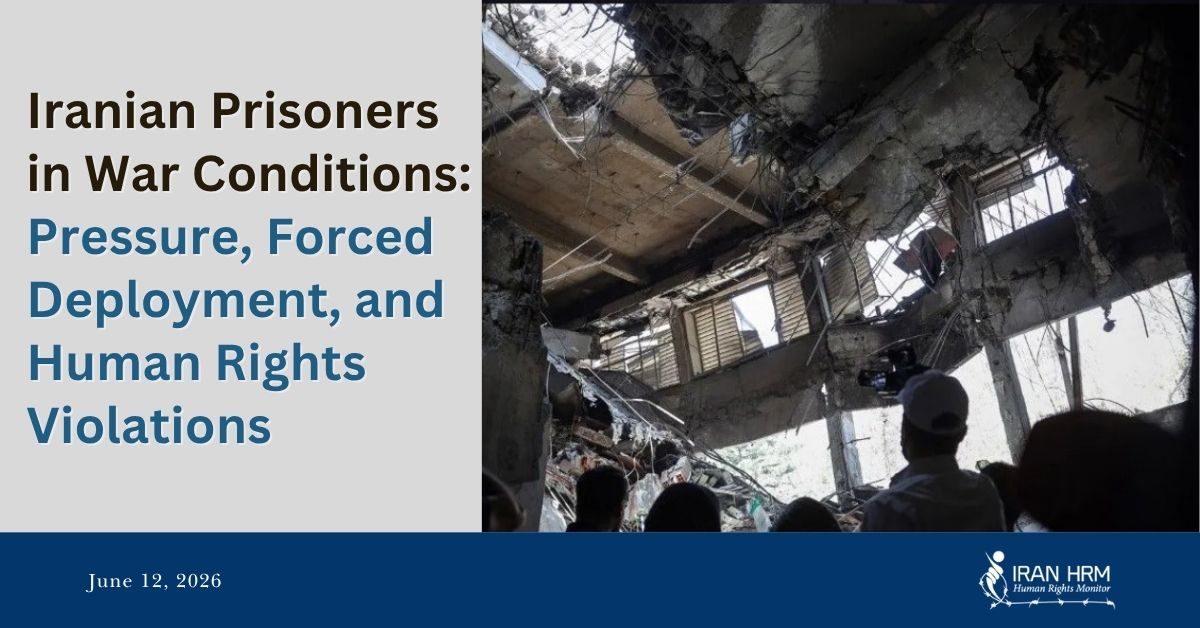
Iranian prisoners in war conditions face simultaneous and escalating dangers: threats resulting from military strikes near prisons and detention centers, heightened securitization of detention facilities, the cutoff or restriction of access to food, water, medical treatment, and communication with family, undisclosed transfers, and pressure on certain prisoners to register for deployment to war zones such as Kharg Island and Hormozgan Province.

This situation demonstrates that prisoners, particularly political prisoners, death-row inmates, protest detainees, sick prisoners, and individuals lacking effective access to a lawyer, have been placed in one of the most vulnerable human rights positions.
According to reports received from inside prisons, authorities in certain facilities, including Kerman Prison, have in recent weeks visited wards and requested prisoners to sign up for deployment to war zones. These requests have been accompanied by promises of monetary payment, improvement of prison conditions, administrative privileges, and in some cases, threats of harsher treatment, restriction of facilities, difficulties regarding furlough, or security pressures. Although these deployments are presented by officials as “voluntary,” the concept of free consent is severely compromised under conditions of confinement and the prisoner’s total dependence on the decisions of prison authorities.
Existing reports indicate that a significant portion of prisoners, despite pressures and promises, have refused to register. Some prisoners have described this scheme as the instrumental exploitation of individuals deprived of liberty, stating that they are being treated as “sacrificial meat.” This resistance occurs under conditions where prisoners are denied free access to the media, secure communication with family and lawyers, and the possibility of protesting without repercussions.
Worsening of Prison Conditions under the Shadow of War
Since the beginning of the war, and concurrent with widespread internet shutdowns, reports have been received regarding food shortages, the closure of prison shops, deprivation of medical treatment, unhygienic and degrading conditions, severe restrictions on access to basic needs, arbitrary transfers, and the increased militarization of the prison environment. Furthermore, at least one prisoner has died as a result of deprivation of medical care.
The control of a number of prisons in provinces such as Khorasan Razavi, Isfahan, Lorestan, West Azerbaijan, Qom, Qvazin, and Tehran has been handed over to special units, and the prison environment has become intensely militarized. In such a situation, on one hand, prisoners lack the possibility of evacuation or seeking independent shelter against the dangers arising from the war, and on the other hand, with the intensification of internal security control within the prison, they are increasingly exposed to pressure, restrictions, sudden transfers, and deprivation of fundamental rights.
Amnesty International has also warned that airstrikes near prisons and the targeting of security centers where detainees are held have placed prisoners, including children, at risk of death or serious injury. The organization has also reported the transfer of certain prisoners to undisclosed locations or areas close to potential military targets, deprivation of adequate food and water, and enforced disappearance.
Deployment of Prisoners to War Zones and the Absence of Free Consent
The deployment or recruitment of prisoners for presence in war zones, even if ostensibly presented under the label of being “voluntary,” must be evaluated within the framework of human rights based on the criteria of free, informed consent, and the absence of coercion. Due to deprivation of liberty, fear of punishment, the need for furlough, medical treatment, visitation, basic facilities, and the possibility of sentence reduction, a prisoner stands in an unequal position vis-à-vis prison authorities. Therefore, if a prisoner consents to deployment under such conditions and influenced by promises of money, furlough, improvement of confinement conditions, or fear of punishment and security pressure, this consent is not an indication of free choice; rather, it can be the result of pressure and helplessness within the prison environment.
Utilizing poverty, debt, family needs, or a prisoner’s hope to improve confinement conditions to induce them to be present in a war zone constitutes the exploitation of the vulnerability of individuals deprived of liberty. This matter becomes particularly more alarming when the specified destinations, such as Kharg Island and Hormozgan Province, are identified as highly sensitive strategic areas exposed to military dangers.
Violations of International Law and Prisoner Treatment Standards
In a state of war, the government remains responsible for protecting the life, dignity, and health of all persons deprived of their liberty. Detention or a criminal conviction does not exempt the state from its obligation to provide food, water, medical treatment, security, communication with family, access to a lawyer, and protection against the dangers of war. The Nelson Mandela Rules stipulate that all prisoners must be treated with respect for their inherent human dignity, and no circumstances can justify torture or cruel, inhuman, or degrading treatment.
Pressuring prisoners to deploy to war zones can stand in conflict with the prohibition of forced or compulsory labor under Article 8 of the International Covenant on Civil and Political Rights, the right to life and personal security, the prohibition of torture and inhuman treatment, and the principle of human dignity. Furthermore, transferring prisoners to undisclosed locations or near potential military targets without notification, clear necessity, and protective guarantees increases the risk of violating the right to life and the prohibition of enforced disappearance.
From the perspective of International Humanitarian Law, prisons and detention centers are inherently civilian objects, and all parties to a conflict are obligated to respect the principles of distinction, proportionality, and precaution. The Office of the UN High Commissioner for Human Rights and the UN Fact-Finding Mission on Iran have warned that during armed conflicts, the protection of civilians, including detainees, becomes more fragile, and state repression can intensify under the shadow of war.
Recent actions against prisoners in Iran stand in direct conflict with the following international principles and treaties:
- The Nelson Mandela Rules (UN General Assembly Resolution 70/175): These rules stipulate that all prisoners must be treated with respect for their inherent human dignity, and no circumstances (even a state of war) can justify torture or cruel, inhuman, or degrading treatment.
- Prohibition of Forced or Compulsory Labor (Article 8 of the International Covenant on Civil and Political Rights – ICCPR): Pressuring prisoners to deploy to war zones is incompatible with this article, the right to life, personal security, and the principle of human dignity. Furthermore, under the International Labour Organization (ILO) Forced Labour Convention (No. 29), any service extracted from a prisoner under pressure, threats, or the promise of essential privileges (such as furlough and release) lacks “free consent” and constitutes forced labor.
- Prohibition of Using “Human Shields” (Third and Fourth Geneva Conventions): According to Article 23 of the Third Geneva Convention and Article 28 of the Fourth Geneva Convention, transferring prisoners to undisclosed locations or close to potential military targets (such as Kharg Island) without notification and protective guarantees constitutes the instrumental exploitation of them as human shields, and severely increases the risk of violating the right to life and enforced disappearance.
The Responsibility of Human Rights Organizations and the International Community
The responsibility of human rights organizations regarding the situation of Iranian prisoners in a state of war extends beyond issuing general statements. For these entities, it is necessary to materially and practically document the names of prisons, the names and conditions of prisoners at risk, transfer locations, methods of pressure for deployment, and the status of access to food, water, medical treatment, telephone calls, visitations, and legal counsel, as well as to record and verify the testimonies of families, released prisoners, lawyers, and former prison staff.
In this regard, taking the following immediate actions by the international community and international mechanisms is essential:
- Clarifying Necessities to Iranian Authorities: It is necessary to exert legal pressure on the Iranian government for the immediate release of all arbitrarily detained prisoners and the granting of humanitarian furloughs or releases for sick, elderly, child, pregnant, political prisoners, and individuals at risk. It is also necessary for authorities to disclose the whereabouts of all transferred individuals and to halt any direct or indirect use of prisoners in military, security, or high-risk activities.
- Immediate Intervention by the International Committee of the Red Cross (ICRC): Given the quasi-war situation and the endangerment of civilian sites, it is essential for the international community to demand the entry and unannounced inspections by international observers and the International Committee of the Red Cross into pressured prisons (particularly Kerman Prison) to guarantee the health and safety of detainees.
- Legal Documentation to Hold Perpetrators Accountable: For United Nations mechanisms, particularly the Special Rapporteur on the situation of human rights in Iran (Mai Sato) and the UN Fact-Finding Mission, it is necessary to record documentation related to pressure on prisoners, undisclosed transfers, deprivation of basic needs, and forced deployment to war zones as potential evidence of international crimes. It is also essential to remind judicial authorities and heads of Iranian prisons that these actions will be legally prosecutable in the future under the principle of Universal Jurisdiction.
Conclusion
Iranian prisoners in war conditions stand at the intersection of war, domestic repression, and the collapse of minimal protections inside prisons. The pressure to deploy prisoners to war zones (such as Kharg Island and Hormozgan Province), alongside food and medical shortages, undisclosed transfers, the militarization of prisons by special units, and the cutting off, of communications, indicates a systematic pattern of violations of rights against individuals deprived of their liberty.
Historical experience demonstrates that governments utilize military crises as a cover and an opportunity for the “silent repression” and purging of detainees. Under such circumstances, it is essential that the protection of the lives and dignity of prisoners does not become marginalized under the shadow of frontline war news; rather, it is necessary for this crucial matter to be transformed into an immediate, specific, and pragmatic demand by human rights organizations, governments, and international mechanisms.