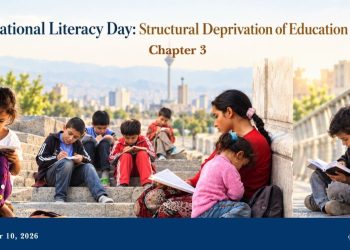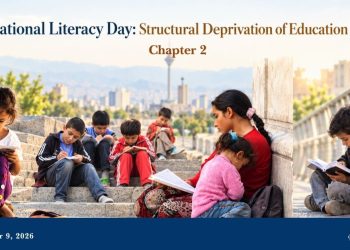
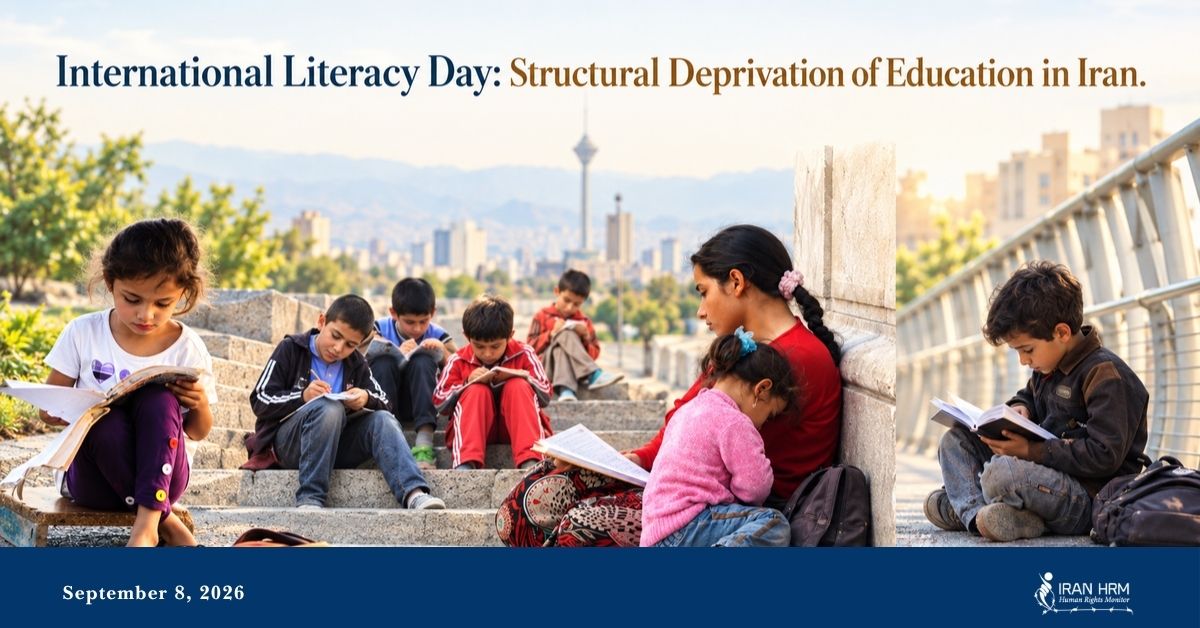
International Literacy Day, observed annually on 8 September, serves as a reminder of the fundamental right of every person to education and literacy. This right forms the basis for access to employment, healthcare, individual autonomy and social participation.

In Iran, despite the government’s legal and international obligations, access to education is not equal for all. Poverty, education-related costs, disparities between urban and rural schools and the increasing class divide within the education system have left many families unable to ensure that their children continue their education.
Official statistics indicate that hundreds of thousands of children and adolescents of school age have either never entered school or have left the education system before completing their studies. This crisis is not limited to children; it also affects adults with inadequate literacy skills and those who remain illiterate.
Key indicators of educational deprivation in Iran
- Statistics on Children Out of School and School Dropouts
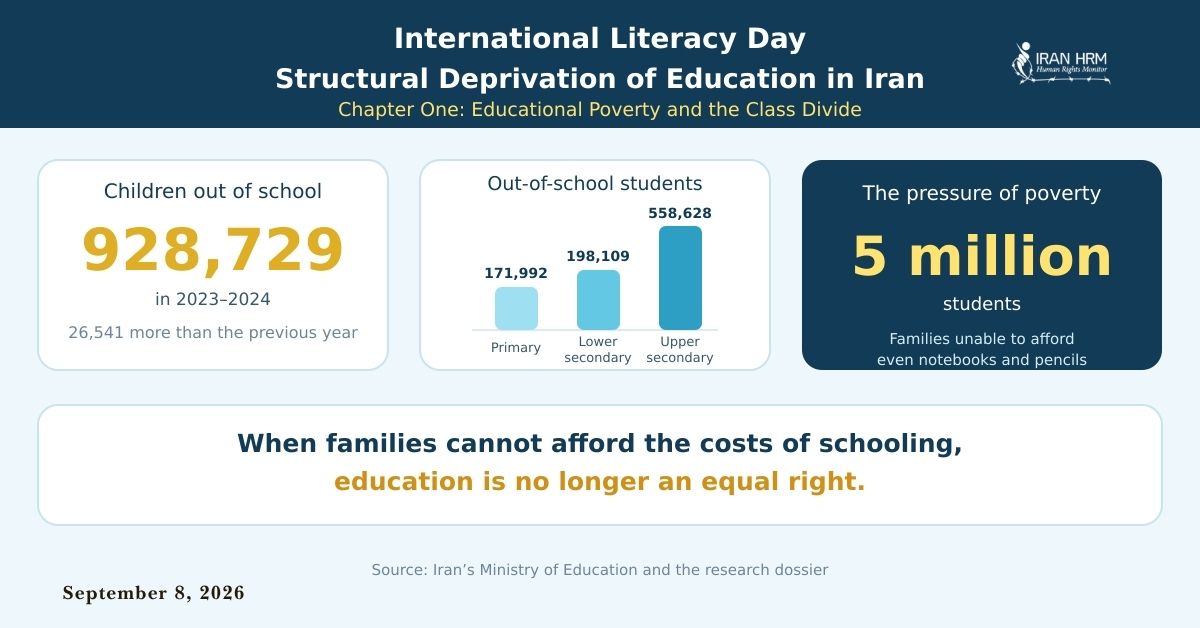
Iran’s Ministry of Education reported that the number of children out of school rose from 902,188 in the 2022–2023 academic year to 928,729 in 2023–2024, representing an increase of 26,541 people in one year.
Official Statistics on Children Out of School
| Indicator | 2022–2023 Academic Year | 2023–2024 Academic Year |
| Children out of school | 902,188 | 928,729 |
| Increase | — | 26,541 |
The figure of 928,729 children in the 2023–2024 academic year was distributed across educational levels as follows:
| Educational level | Number |
| Primary education | 171,992 |
| Lower secondary education | 198,109 |
| Upper secondary education | 558,628 |
| Total | 928,729 |
More than 756,000 of these children were in lower or upper secondary education. This concentration indicates that barriers to education become more severe after the completion of primary school, when transportation costs, the distance to schools, entry into the labour market, early marriage and family economic pressures play a greater role.
The Difference Between Children Out of School and School Dropouts
“Children out of school” and “school dropouts” are not identical categories. A child classified as out of school may not have enrolled during the relevant academic year, whereas a school dropout is a student who entered school but subsequently abandoned their education.
| Educational level | Dropouts in 2022–2023 | Dropouts in 2024–2025 |
| Primary education | 87,544 | 84,001 |
| Lower secondary education | 149,288 | 130,432 |
| Upper secondary education | 50,785 | 32,809 |
| Total | 287,617 | 247,242 |
The decline in the official number of school dropouts does not, by itself, indicate an improvement in the education system, as the number of children who did not enrol increased during the same period. In addition, official statistics may include individuals who have migrated, died or been removed from student records because of severe intellectual disabilities.
In 2025, the Ministry of Education reported that 152,287 children between the ages of six and eleven had been identified as out of school. It stated that approximately 29,000 of them had returned to school. This figure indicates that even at the primary level, the identification of children out of school and their return to education remain incomplete.
- Poverty as the Main Barrier to Accessing Education
Although public education in Iran is required to be free under Article 30 of the Constitution, families face numerous costs in sending their children to school, including:
- school uniforms;
- textbooks and stationery;
- transportation;
- food;
- digital equipment;
- private tutoring;
- payments requested by schools.
According to the deputy head of Iran’s stationery producers’ association, the families of approximately five million students cannot afford even basic items such as notebooks and pencils.
Examples of Education-Related Costs
| Educational item | Reported figure or increase |
| School uniform in 2024 | More than 1.5 million tomans |
| Lowest reported price of a schoolbag | Approximately 548,000 tomans |
| Average price of textbooks in spring 2024 | Approximately 140,000 tomans |
| Increase in textbook prices compared with the previous year | 32 percent |
| Minimum reported tuition at private schools | 35 million tomans per year |
| Highest reported private-school tuition | 80 million tomans per year |
| Study-material costs for some university entrance candidates | Approximately 300 million tomans |
For families facing poverty, unemployment and declining purchasing power, these costs can gradually force children out of school. In many cases, children enter the labour market to support household income or fall away from education because their families cannot meet the basic costs of schooling.
This process creates a cycle of poverty and educational deprivation: leaving school reduces future employment opportunities and transfers economic hardship to the next generation.
- Food Poverty and Its Impact on Learning
Educational poverty is also directly connected to children’s nutritional conditions. Hadi Mousavi-Nik, Director-General of Social Welfare Studies at the Ministry of Cooperatives, Labour and Social Welfare, stated that 57 percent of the population suffers from malnutrition and that more than 14.5 million children are included in this group. Nearly 10 million of these children are under the age of twelve.
This figure requires verification against the precise definition of “malnutrition” used by the source. Nevertheless, deprivation of essential foods such as meat, poultry, fruit and protein can weaken children physically and cognitively and affect their concentration, learning and academic performance.
Under such conditions, children who suffer from food insecurity face not only a higher risk of dropping out, but also unequal learning opportunities even when they remain enrolled in school.
- The Increasing Class Divide in Education
The gap between privileged schools and public schools in Iran has continued to widen. Wealthier families can send their children to private schools, schools for gifted students and private tutoring programmers and can purchase expensive educational materials. Students from low-income families, by contrast, often attend overcrowded and poorly equipped schools.
According to the data compiled in the research file:
- more than one million students attend private or non-governmental schools;
- approximately 100,000 students attend schools for gifted students;
- around 15 million students attend public schools affected by shortages of facilities, teachers and equipment;
- reported private-school tuition ranges from 35 to 80 million tomans per year.
Students in better-resourced schools have greater access to smaller classes, laboratories, educational equipment and private tutoring. Students in public schools, particularly in disadvantaged areas, are more likely to study in overcrowded classrooms and deteriorating buildings with inadequate teaching staff.
This divide is also visible in university entrance examinations. The share of ordinary public schools among the highest-ranking candidates has declined, while students from gifted, model and non-governmental schools account for a larger proportion of admissions to leading universities.
As a result, academic success has become increasingly dependent on a family’s financial capacity. Education, which should serve as a means of reducing inequality, has instead become a mechanism for reproducing class divisions.
- Inadequate Funding and the Transfer of Costs to Families
The Parliamentary Research Center has reported that most of the education budget is spent on salaries and wages, leaving limited resources for school repairs, equipment, infrastructure development and quality improvement.
According to the reports compiled in the research file:
- the average share of the Ministry of Education in the public budget during the 2010s was approximately 9 percent;
- higher-level policy documents set a target of 20 percent;
- less than 2 percent of gross domestic product is allocated to education;
- approximately 8.2 percent of government expenditure reaches schools;
- only around 2 percent remains for repairs and new equipment.
This situation has shifted a significant portion of education-related costs onto families. Families unable to meet these costs may be forced to choose between food, healthcare, housing and their children’s education.
Conclusion to Chapter One
The available statistics indicate that Iran’s education crisis takes three principal forms:
- Complete exclusion from school: Hundreds of thousands of children and adolescents of school age do not enroll.
- School dropout: Hundreds of thousands of students leave school after entering the education system.
- Unequal education: Millions of students attend school but do not receive equal educational quality because of poverty, overcrowded classrooms and disparities in resources.
These conditions demonstrate that, despite the government’s legal obligations, education in Iran is neither genuinely free nor equally accessible for many families. Access to education is increasingly determined by social class, income, place of residence and household financial capacity.
Follow Chapter Two:
Women, Children and Minorities: Victims of Educational Discrimination
Chapter Two examines the situation of women and girls, child labourers and children out of school, Afghan children, persons with disabilities, and ethnic and linguistic minorities, including Kurds and Baluch people.