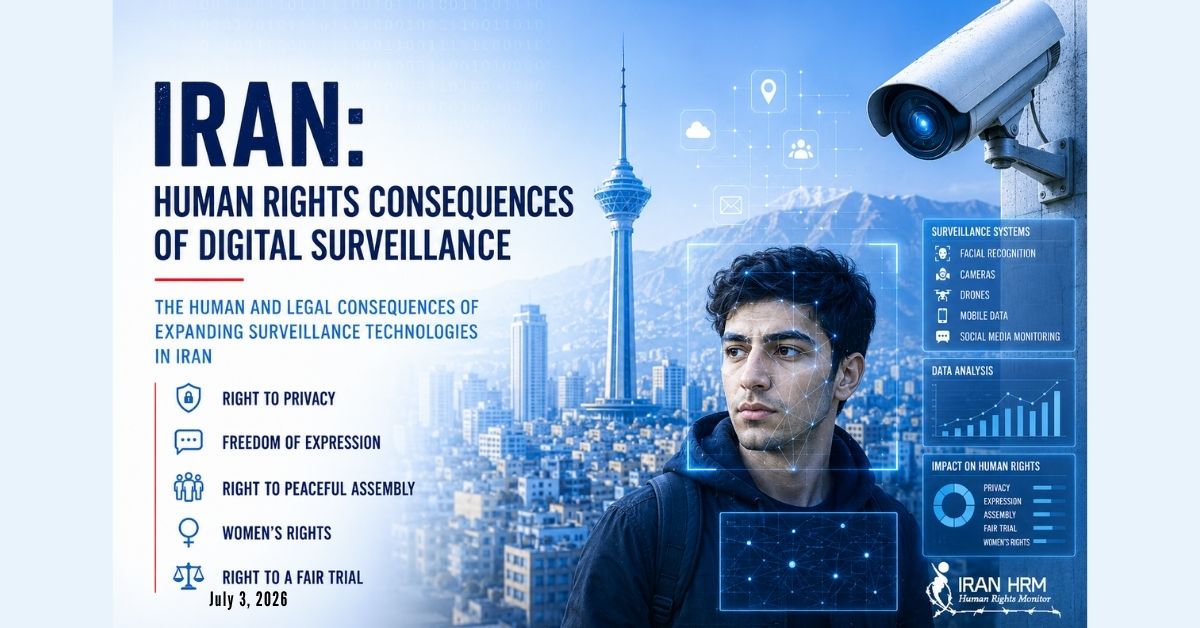
The Human and Legal Consequences of Expanding Surveillance Technologies in Iran
The first report in this series examined evidence of the use of emerging technologies to identify, track, and monitor citizens in Iran. A more fundamental question, however, is what consequences the use of these technologies has for human rights.

Drawing on the same official documents and evidence, this report examines how the expansion of digital surveillance affects the right to privacy, freedom of expression, the right to peaceful assembly, women’s rights, and the right to a fair trial. It further demonstrates how, in the absence of effective oversight and accountability, technology can become a powerful instrument for violating the fundamental rights and freedoms of citizens.
Privacy: The First Casualty of Digital Surveillance
The United Nations Independent International Fact-Finding Mission has reported that following the arrest of protesters, security forces systematically confiscated their mobile phones and extracted information including messages, photographs, videos, contact lists, location data, and social media accounts. In some cases, this information was subsequently used to identify, summon, or arrest other individuals.
This practice has not been limited to mobile phones. The Fact-Finding Mission also documented that during 2024, the SIM cards of a number of civil society activists, journalists, and university students were deactivated, disrupting their communications as well as their access to numerous essential digital services. Documented reports further indicate that security agencies have used telecommunications data and mobile phone location information to track certain citizens.
These practices, carried out without independent judicial oversight and without effective legal safeguards, pose a serious threat to the right to privacy and the confidentiality of communications, rights protected under Article 17 of the International Covenant on Civil and Political Rights.
Women: The Primary Targets of Smart Surveillance
Official documents and international reports indicate that women have been the first group to be subjected on a large scale to the government’s expanding use of advanced surveillance technologies. Article 28 of the proposed Family Support through the Promotion of the Culture of Chastity and Hijab Bill authorizes the use of “smart systems,” “fixed and mobile cameras,” and “artificial intelligence” to detect and record alleged violations. At the same time, Ahmadreza Radan, Commander-in-Chief of Iran’s Law Enforcement Command, publicly confirmed the use of “cameras and smart equipment” to identify individuals.
The United Nations Independent International Fact-Finding Mission has documented the deployment of camera-equipped drones at the Tehran International Book Fair and on Kish Island during 2024. Reports by the Associated Press further indicate that surveillance cameras, facial recognition technology, and automated warning text messages formed part of the enforcement mechanism of the “Noor Plan.”
The use of advanced technologies to enforce compulsory dress regulations against women has transformed digital surveillance from a security tool into an instrument of gender-based discrimination in everyday life. Beyond violating the right to privacy, these measures also affect women’s rights to freedom of movement, personal autonomy, and the equal enjoyment of fundamental rights and freedoms.
The Right to Peaceful Assembly Under Digital Surveillance
Surveillance technologies have also affected citizens’ ability to exercise their right to peaceful assembly. Reports by Reuters and the Associated Press indicate that during periods of protest, the ruling regime in Iran relied not only on the widespread deployment of security forces but also on internet shutdowns, surveillance cameras, and drones to control public spaces and identify certain protesters.
On January 9, 2026, Reuters reported that internet access and telephone communications were restricted or suspended in certain areas as protests unfolded. One week later, Reuters reported that drones were flying over Tehran following the suppression of the demonstrations. The Associated Press also reported that footage obtained from municipal surveillance cameras, privately owned security cameras, and drones was used to identify and arrest some protesters.
The combined use of surveillance technologies and communication restrictions affects far more than the identification of individuals. It also limits citizens’ ability to share information, coordinate peaceful activities, document human rights violations, and participate freely in public assemblies. Under such circumstances, digital surveillance can itself become a significant deterrent to the exercise of the right to peaceful assembly.
Freedom of Expression Under Continuous Surveillance
Digital surveillance extends far beyond the identification and arrest of citizens. It also shapes how individuals use both public spaces and online platforms. According to the United Nations Independent International Fact-Finding Mission, on April 23, 2024, the Commander of the West Tehran Police announced that 21 Instagram accounts belonging to prominent women had been blocked and that their online activities were under continuous monitoring as part of the “Noor Plan.”
United Nations reports further indicate that citizens’ activities on social media have, in some cases, served as grounds for summonses, interrogations, or the imposition of security-related restrictions. At the same time, the use of smart surveillance cameras, facial recognition systems, and automated warning text messages has reinforced concerns that online activity, much like physical presence in public spaces, is subject to continuous state surveillance.
Under these circumstances, many citizens may refrain from expressing their views, sharing images, or voicing support for public protests. This climate of self-censorship, even without direct action against every individual user, can substantially restrict freedom of expression, a right protected under Article 19 of the International Covenant on Civil and Political Rights.
Digital Data as a Tool for Security Case Building
The available evidence indicates that digital data in Iran is used not only to identify citizens but, in some instances, also during interrogations, the construction of security-related cases, and subsequent judicial proceedings. Ahmadreza Radan, Commander-in-Chief of Iran’s Law Enforcement Command, stated regarding the implementation of surveillance systems:
“Individuals are identified through smart systems.”
This official statement confirms the government’s use of advanced technologies for the identification of individuals.
The United Nations Independent International Fact-Finding Mission has also reported that interrogators routinely used information extracted from the mobile phones of detainees during interrogations, for intimidation, and in some instances as evidence in security-related cases. The extracted data included messages, photographs, contact lists, and information from social media accounts. In certain cases, it also led to the identification of additional individuals and the expansion of security investigations.
Reports by the former United Nations Special Rapporteur on the situation of human rights in Iran, Professor Javaid Rehman, together with the findings of the United Nations Fact-Finding Mission, further indicate that digital information extracted from mobile phones and citizens’ online activities has been used in security-related prosecutions and judicial proceedings. These findings suggest that surveillance technologies have, in some instances, evolved beyond initial identification and become instruments for building security cases and facilitating criminal prosecution.
The use of digital evidence in security-related cases, without transparency regarding the methods of collection, verification, or the opportunity for independent examination by defendants and their legal counsel, poses serious challenges to the right to an effective defense and the guarantees of a fair trial.
Documented Cases: The Human Impact of Digital Surveillance
Although many cases involving digital surveillance in Iran never become public because of security restrictions, a number of credible investigations provide a clear picture of the human consequences of these technologies.
One of the most thoroughly documented cases was published by Forbidden Stories, which recounts the experience of a 13-year-old girl identified under the pseudonym “Hasti.” According to the investigation, security forces reviewed footage from a bank’s surveillance camera, identified her father, and subsequently located Hasti through her school before pursuing and arresting her. The report states that the incident resulted in permanent physical injuries and lasting neurological damage.
Another documented case concerns a woman identified under the pseudonym “Maryam.” After appearing in a café without the mandatory hijab, she was confronted in court with a photograph of herself. Recalling the incident, she stated: “There was no other way they could have identified me.” Although this case alone does not establish the use of facial recognition systems, when considered alongside other documented evidence it reinforces concerns about the expanding use of digital identification technologies against citizens.
On a broader scale, the United Nations Independent International Fact-Finding Mission and the Associated Press reported that in April 2024, approximately 200 female students were denied entry to Amirkabir University of Technology after facial recognition technology was deployed at the university’s entrance. This incident represents one of the best documented examples of facial recognition technology being used at an educational institution in Iran.
These cases demonstrate that digital surveillance is not merely a technical or security-related issue. It can have direct and profound consequences for individuals’ lives, liberty, education, and future opportunities.
The Responsibility of Governments and Technology Suppliers
The expansion of surveillance technologies in Iran is not solely a matter of the Islamic Republic’s domestic policies. The role of foreign companies and technology suppliers has also attracted increasing attention from international institutions.
Joint investigations by Le Monde and Forbidden Stories reported cooperation between Iranian institutions and the Russian company NtechLab, the developer of the FindFace facial recognition platform, a technology capable of identifying individuals and matching facial images against large databases.
The cybersecurity firm Threatstone71 has also reported that several companies affiliated with the Islamic Revolutionary Guard Corps, including Tarasel and Eliant Gostar, have cooperated with Chinese companies in the development of surveillance and cyber infrastructure. While some of these findings continue to require additional independent verification, taken together with investigative reporting and publicly available documentation they present a broader picture of the transnational transfer of surveillance technologies to Iran.
Under the United Nations Guiding Principles on Business and Human Rights, companies also bear a responsibility to ensure that their products and services are not used to facilitate human rights violations. The transfer of technologies that may be employed to suppress citizens is therefore not merely a commercial matter but may also raise questions of international corporate responsibility and accountability.
Conclusion
The body of evidence examined throughout these two reports demonstrates that, over recent years, the Islamic Republic has expanded its surveillance capabilities while simultaneously employing emerging technologies to strengthen its systems for identifying, monitoring, and suppressing citizens. Smart surveillance cameras, facial recognition systems, drones, the extraction of mobile phone data, social media monitoring, and other digital technologies, operating alongside existing security institutions, have substantially increased the scope and effectiveness of state surveillance.
Technology is not inherently incompatible with human rights. What transforms it into an instrument of repression is the manner in which it is used. In a country where United Nations reports and other international investigations have, for years, documented widespread arrests, enforced disappearances, torture, unfair trials, and executions, the deployment of these technologies raises serious concerns about the expansion of digital repression and the further erosion of citizens’ fundamental rights and freedoms.
Iran’s experience demonstrates that in the absence of the rule of law, independent judicial oversight, transparency, and accountability, technological progress does not necessarily lead to greater freedom. Instead, it can significantly enhance the state’s capacity to monitor, control, and restrict fundamental rights and civil liberties. For this reason, greater scrutiny of transfers of surveillance technologies, closer examination of the responsibilities of governments and technology suppliers, and stronger international accountability mechanisms are essential components of global efforts to prevent the misuse of technology against human rights.