The collapse of six death sentences in the high-profile “Ekbatan Township” case has raised serious concerns about the use of capital punishment, coerced confessions, and security-based prosecutions against protesters in Iran. What began as one of the most severe judicial responses to the 2022 nationwide uprising ultimately ended with three defendants acquitted of murder charges and three others receiving reduced prison sentences after the Supreme Court overturned the original death verdicts.

The dramatic reversal has intensified scrutiny of the ruling regime in Iran’s handling of protest-related cases; particularly the role of Revolutionary Courts, forced confessions, and media-driven criminalization before trial.
The case originated after the death of Basij member Arman Aliverdi during clashes in Tehran’s Ekbatan residential complex in October 2022. Following the incident, security forces launched sweeping raids across the neighborhood and detained more than 50 young residents.
From the outset, the case moved beyond an ordinary criminal investigation and became part of a broader security response to the nationwide protests that erupted after the death of Mahsa Amini.
 A dual judicial structure designed for security prosecutions
According to judicial documents and official statements, the Ekbatan case was deliberately divided into two parallel tracks: one before the Revolutionary Court on security-related charges such as “Moharebeh” and “assembly and collusion against national security”; and another before Criminal Court Branch 13 on homicide allegations.
Human rights observers say this structure allowed the authorities to preserve a path toward execution even if direct criminal responsibility for the killing could not be conclusively established.
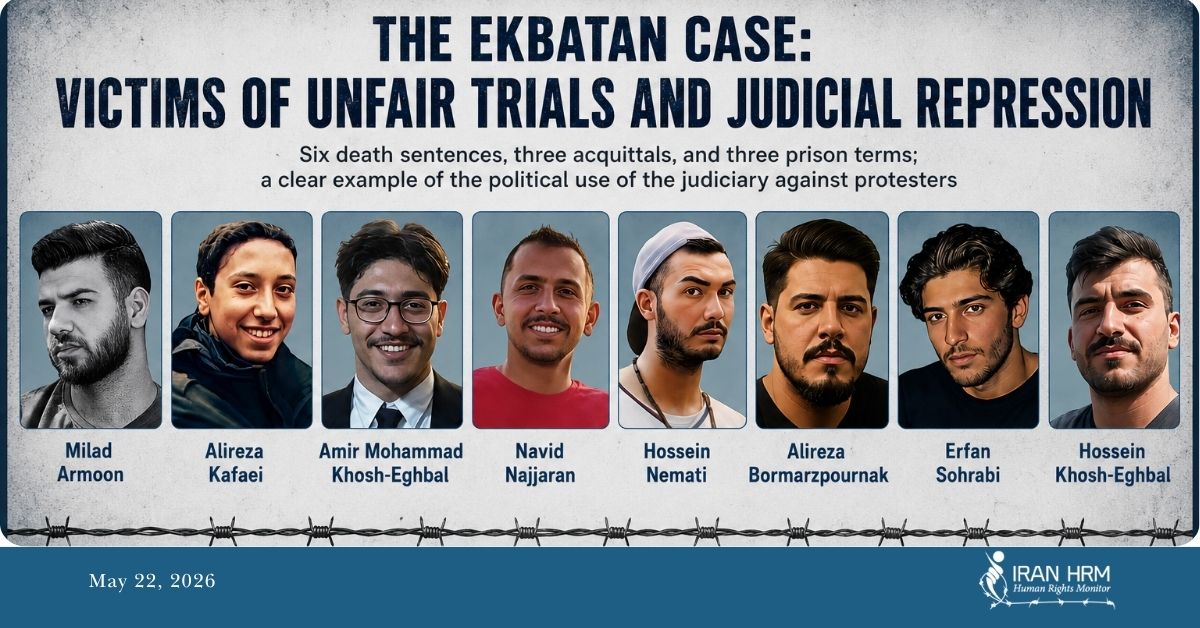
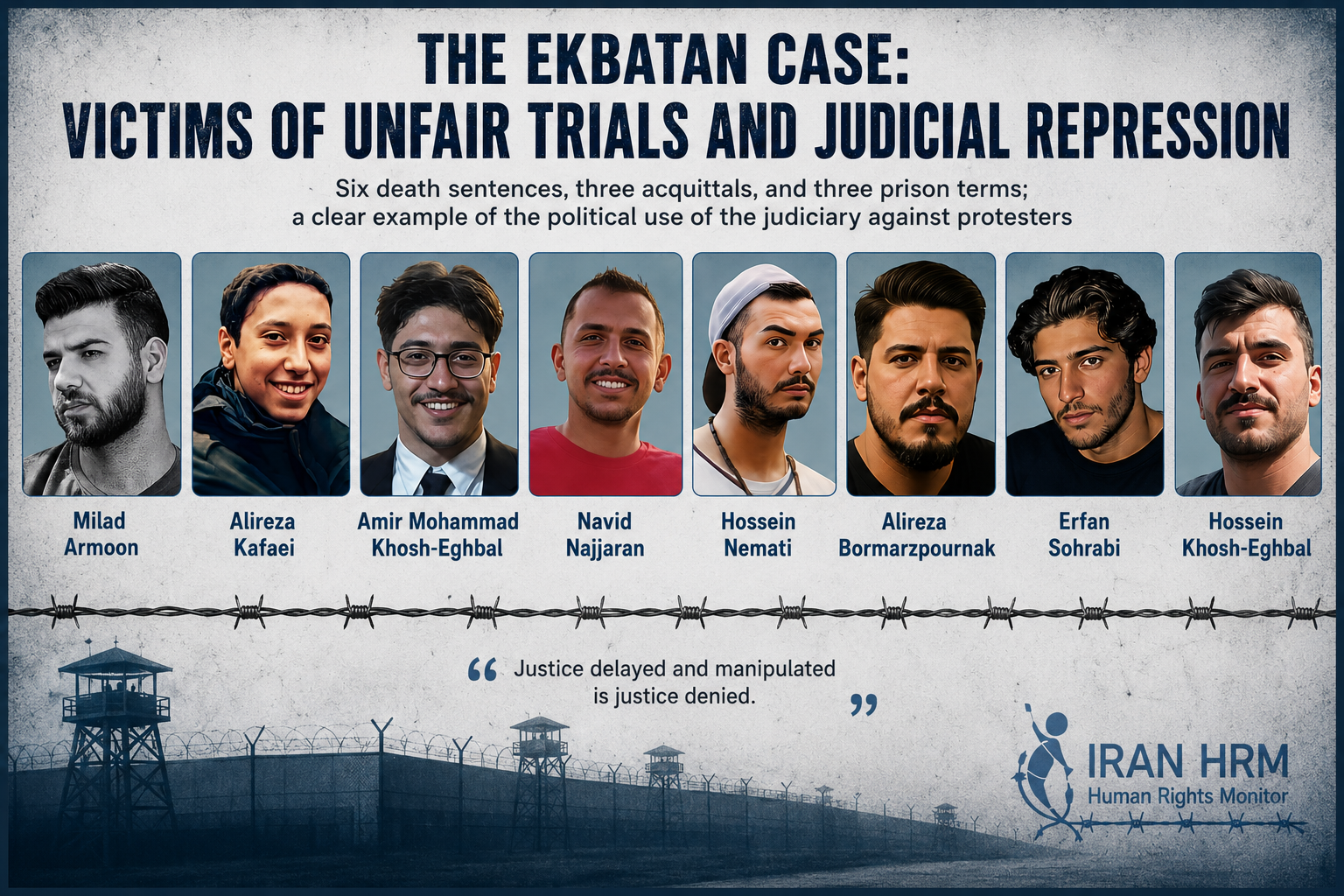
Under this framework, six defendants; Milad Armoon, Alireza Kafaei, Amir Mohammad Khosh-Eghbal, Navid Najjaran, Hossein Nemati, and Alireza Bormarzpournak; initially received death sentences in November 2024.
However, the Supreme Court later overturned all six death verdicts after acknowledging major evidentiary deficiencies and ambiguities in the prosecution file.
Following retrial proceedings, three defendants were acquitted of murder charges entirely, while the remaining three received five-year prison terms and partial blood money penalties instead of execution.
The scale of this reversal has raised serious questions regarding how death sentences were issued in the first place.
Forced confessions and prolonged solitary confinement
Defense lawyers and defendants repeatedly stated that the prosecution relied heavily on confessions extracted during prolonged incommunicado detention.
Milad Armoon reportedly told the court:
“I was kept in a solitary cell for months. I never possessed a weapon, nor did I strike Arman Aliverdi. The interrogators told me exactly what to say in front of the camera, warning that if I did not repeat their words, my family would be arrested.”
Other defendants described prolonged blindfolding, sensory deprivation, physical violence, and pressure to sign blank documents later turned into written confessions.
Independent lawyers involved in the case argued that prosecutors failed to provide reliable forensic evidence linking any specific defendant to the fatal injuries. According to defense statements, there was no conclusive DNA evidence, fingerprint analysis, or unambiguous video documentation establishing individual responsibility for the death.
The final retrial outcome appeared to reinforce these concerns. The eventual acquittals and sentence reductions suggested that the original prosecution had failed to establish clear individual causation required for capital punishment under Iranian criminal law.
Media criminalization before trial
Long before any final judgment was issued, Iranian state-affiliated media outlets broadcast edited videos, reenactments, and televised “documentaries” portraying the detainees as guilty.
According to reports, blindfolded defendants were taken back to the Ekbatan residential complex under armed escort and filmed reenacting the alleged attack before judicial review had been completed.
State-linked outlets reportedly described the defendants as “rioters,” “terrorists,” and “foreign-backed elements,” framing the case within the regime’s broader security narrative surrounding the 2022 protests.
Human rights analysts say such broadcasts undermine the presumption of innocence and place political pressure on judges handling protest-related prosecutions.
Judges linked to politically sensitive prosecutions
The case also drew attention because of the judicial figures overseeing its security-related dimensions.
Judge Abolqasem Salavati, widely known for presiding over political and protest cases, reportedly intervened to block the release of several defendants despite bail orders issued by Criminal Court Branch 13.
Salavati has been sanctioned by both the United States and the European Union over his role in unfair trials and severe sentences against political dissidents.
Judge Iman Afshari, another Revolutionary Court judge involved in parallel security proceedings connected to the case, has similarly overseen multiple prosecutions targeting protesters, activists, and religious minorities.
The involvement of these judges reinforced concerns that the Ekbatan proceedings formed part of a broader pattern of politically driven judicial repression rather than an ordinary criminal prosecution.
A broader pattern in protest cases
Human rights organizations and UN mechanisms have repeatedly warned that the ruling regime in Iran has increasingly used the death penalty and national security charges to suppress dissent following the 2022 uprising.
According to the UN Fact-Finding Mission on Iran and international legal observers, cases linked to the protests have frequently involved:
- prolonged arbitrary detention,
- restricted access to lawyers,
- forced confessions,
- closed-door proceedings,
- and broad security accusations unsupported by transparent evidence.
The Ekbatan case illustrates how these mechanisms can transform a politically sensitive protest پرونده into a capital prosecution before evidentiary standards are fully established.
The Ekbatan case illustrates how politically sensitive protest-related cases in Iran can rapidly evolve into capital prosecutions before evidentiary standards are firmly established.
The eventual collapse of all six death sentences did not erase the years of detention, psychological pressure, and risk of execution faced by the defendants. Instead, the outcome exposed the fragility of the original case and intensified concerns about the structural use of the judiciary as a tool of political intimidation in Iran’s protest-related prosecutions.
Conclusion
The Ekbatan case reflects broader patterns in the ruling regime in Iran’s handling of protest-related prosecutions; where security narratives, coerced confessions, media criminalization, and parallel judicial mechanisms can place defendants at risk of execution before individual criminal responsibility is credibly established.
Although the death sentences were ultimately overturned, the case exposed how capital punishment can be used as a tool of intimidation in politically sensitive cases. The years of detention, solitary confinement, televised confessions, and prolonged exposure to execution left lasting psychological and legal consequences for the defendants and their families.
Human rights observers say the collapse of the original verdicts underscores the urgent need for independent investigations into protest-related prosecutions in Iran, accountability for due process violations, and greater international scrutiny of the use of death penalty charges against protesters and political detainees.