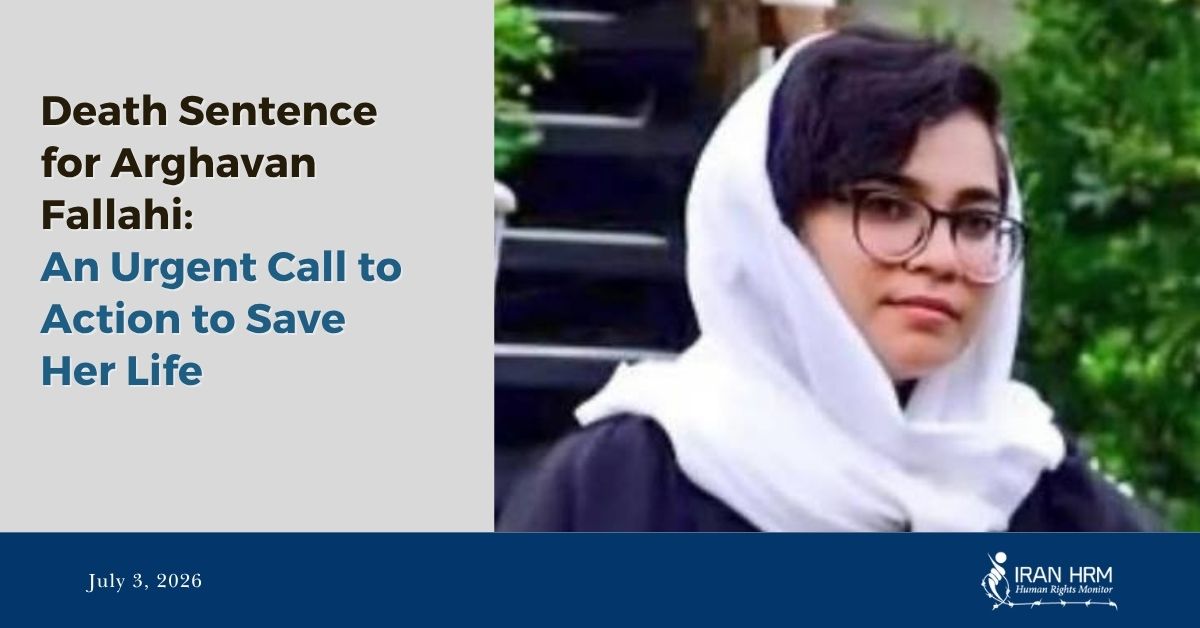
The death sentence issued for Arghavan Fallahi stands as an immediate and critical warning regarding the imminent danger of execution facing a female political prisoner in Iran. Arghavan Fallahi, 25 years old, was reportedly sentenced to death on July 1, 2026 (10 Tir 1405) by Branch 15 of the Tehran Revolutionary Court, presided over by Judge Abolghasem Salavati (notoriously known as the “Execution Judge”), with the verdict formally communicated to her through her legal counsel. The acute urgency of this case stems from the fact that the primary accusations against her were framed within security cases linked to the People’s Mojahedin Organization of Iran (PMOI/MEK). This death sentence follows months of arbitrary detention, prolonged solitary confinement, enforced disappearance, relentless interrogations, and explicit reports of torture and coercive pressure aimed at manufacturing a state security case.

Arghavan Fallahi was arrested on January 25, 2025 (6 Bahman 1403) in the city of Parand and subsequently transferred to the high-security wards of Evin Prison, including Wards 209 and 241. She was subjected to solitary confinement for approximately five months—a period defined not merely by “harsh conditions,” but by an environment that family testimonies describe as involving continuous interrogations, physical and psychological torture, total deprivation of communication, and systematic pressure to extract forced confessions for the purpose of judicial framing. Following the attacks on Evin Prison amidst the military conflict between Iran and Israel and the subsequent evacuation of the facility in May/June 2025 (Khordad 1404), she was initially transferred to the Greater Tehran Central Penitentiary (Fashafuye) and later to Qarchak Prison in Varamin, before being moved back to Evin Prison.
This case is a direct continuation of the broader pattern of repression initiated against the Fallahi family in 2022 (1401). On November 4, 2022 (13 Aban 1401), Arghavan Fallahi was arrested during a trip from Isfahan to Shiraz, alongside her father Nasrallah Fallahi, her brother Ardavan Fallahi, and Parvin Mir’asan. They were tried before the Tehran Revolutionary Court under Judge Iman Afshari on charges including “membership in the People’s Mojahedin Organization of Iran,” “assembly and collusion against internal and external security,” and “propaganda against the state.” The verdicts rendered in that case were as follows: Nasrallah Fallahi received 4 years in prison, Parvin Mir’asan 4 years, Arghavan Fallahi 2 years, and Ardavan Fallahi 1 year.
Nasrallah Fallahi, Arghavan’s father and a fellow political prisoner, declared in an audio plea smuggled from the Greater Tehran Penitentiary that Ministry of Intelligence agents detained his daughter “without a shred of evidence” and subjected her to “continuous torture during this period” to manufacture a case against her. He stated that throughout this entire duration (from the initial arrest until August 3, 2025 [12 Mordad 1404], when the audio plea was made public), he had no verifiable information regarding his daughter. Despite repeated inquiries, she was denied even a brief phone call. On the day Evin Prison was attacked and evacuated, while he himself was injured and bleeding, his sole concern was to discover “whether Arghavan was alive or dead.” He further warned of Arghavan’s severe nervous migraines and the high risk of her being denied essential medication, appealing to the public with the words: “Please be my voice and the voice of my Arghavan.”
Manifest Violation of Due Process and the Right to Life
The issuance of the death penalty for Arghavan Fallahi occurs within a context marred by grave, systematic violations of judicial due process: national security detention, prolonged solitary confinement, continuous interrogation, reported physical and psychological torture, denial of regular family contact, severe concerns over medical deprivation, restricted access to effective legal counsel, and a trial conducted by a court whose independence and impartiality are profoundly compromised. Such a flawed process strips the death sentence of any judicial legitimacy, rendering it an immediate and unlawful threat to the right to life.
Under Article 6 of the International Covenant on Civil and Political Rights (ICCPR), the right to life must not be arbitrarily deprived. Furthermore, Article 7 of the Covenant explicitly prohibits torture and cruel, inhuman, or degrading treatment; Article 9 protects against arbitrary arrest and detention; and Article 14 guarantees the right to a fair trial, effective legal defense, and an independent tribunal. Issuing a death sentence following a procedure rife with such fundamental breaches constitutes a double violation of both the right to life and due process. These actions not only violate the provisions of the ICCPR but stand in direct opposition to the core spirit of the UN Convention Against Torture (CAT), which strictly bans any form of coercion, inhuman treatment, and forced confession.
The Nelson Mandela Rules similarly establish that prolonged solitary confinement, deprivation of medical care, denial of family contact, and restriction of legal support violate the minimum international standards for the treatment of prisoners. Consequently, the death sentence against Arghavan Fallahi must be viewed not merely as an isolated individual ruling, but as an immediate test of international accountability mechanisms against a systemic pattern of political repression and the state’s weaponization of capital punishment.
This threat does not unfold in a vacuum. In the months following the outbreak of military conflicts involving Iran, the United States, and Israel, the surge in political executions has escalated drastically. According to published reports, at least 8 individuals, “Resistance Units” (Kanoon-haye Shoorashi), accused of ties to or membership in the People’s Mojahedin Organization of Iran have been executed alongside other political prisoners. This trajectory clearly demonstrates that the Islamic Republic is leveraging wartime conditions and the international community’s absorption with regional crises to intensify domestic crackdowns, execute political dissidents, and instill public terror. Therefore, the death sentence of Arghavan Fallahi must be evaluated strictly within the context of this perilous wave of executions, rather than as an isolated case.
Call for Urgent Action
In light of the extreme urgency and the imminent threat to human life, this call is issued directly to the following authorities, demanding decisive and immediate action:
- United Nations Human Rights Bodies: Ms. Mai Sato (Special Rapporteur on the situation of human rights in the Islamic Republic of Iran), the Working Group on Arbitrary Detention, the Special Rapporteur on torture and other cruel, inhuman or degrading treatment or punishment, the Special Rapporteur on extrajudicial, summary or arbitrary executions, the Special Rapporteur on violence against women and girls, and the UN High Commissioner for Human Rights.
- International Bodies and Governments: The European Union and democratic governments worldwide.
- International Non-Governmental Organizations: Amnesty International and all human rights advocacy organizations.
This case demands an immediate, public, and trackable response; silence or confidential diplomatic correspondence is entirely inadequate. Accordingly, the following urgent demands and actions need to be prioritized on the international agenda:
- The immediate issuance of public statements demanding an absolute stay of execution for Arghavan Fallahi.
- The mobilization of international pressure on the Iranian government to annul the death sentence and grant a comprehensive judicial review of the case in total conformity with international fair trial standards.
- The deployment of all available diplomatic and legal avenues to secure Arghavan Fallahi immediate, unhindered access to independent legal counsel, her family, and adequate medical care.
- Compelling Iranian authorities to immediately disclose her exact place of detention and health status, guarantee her access to essential medications, and ensure regular communication channels with her family.
- The initiation of an independent, immediate international inquiry into her months-long detention in solitary confinement, continuous interrogation, physical and psychological torture, and the coercive measures utilized to manufacture security charges.
- A decisive demand for an international fact-finding delegation to visit Evin, Fashafuye, and Qarchak prisons, and to hold direct, unmonitored meetings with Arghavan Fallahi and other political prisoners.
- The consistent prioritization of Arghavan Fallahi’s case in all formal diplomatic communications with the Iranian government, Human Rights Council sessions, and public human rights monitoring reports.
- The formal and explicit declaration that no international negotiations concerning peace, ceasefires, or political agreements with the Islamic Republic should advance without compelling the regime to halt executions, cease the use of torture, end prolonged solitary confinement, and release political prisoners.
Conclusion
The life of Arghavan Fallahi is in immediate danger. Every single day of delay paves a smoother path toward the execution of this sentence. The international community must act openly and without hesitation right now: halt the death sentence, dismantle fabricated security charges, guarantee her health and medical access, secure immediate contact with her independent lawyer and family, investigate the allegations of torture and solitary confinement, and hold the perpetrators of these violations accountable. Silence in the face of Arghavan Fallahi’s death sentence is complicity in political repression, torture, and the systematic violation of the right to life.