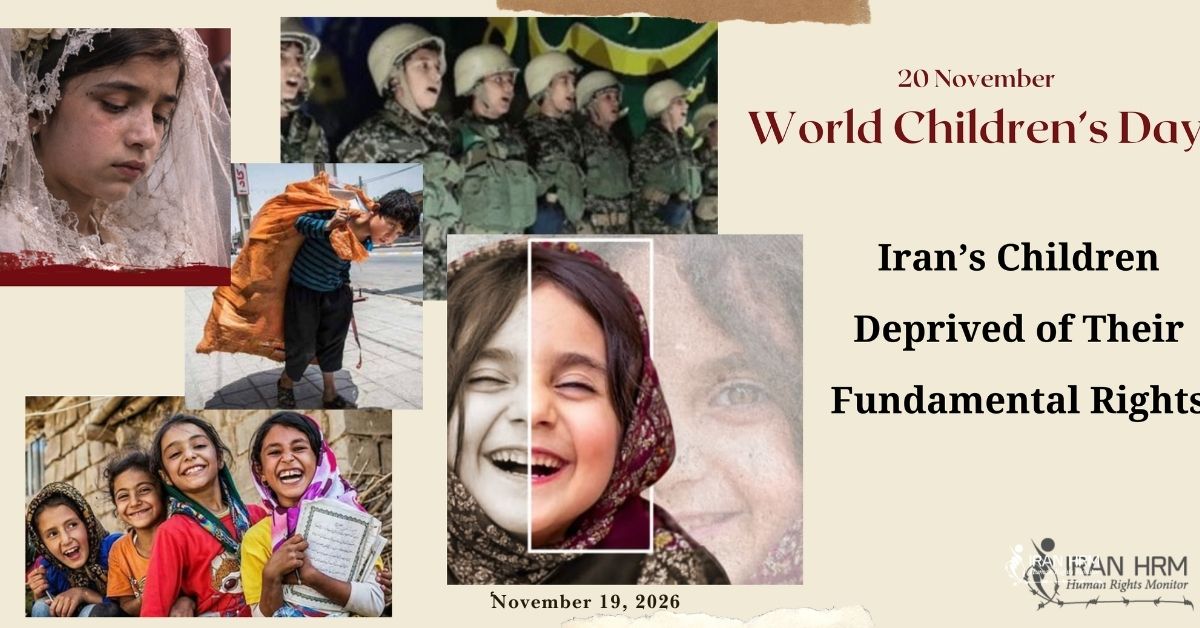
Poverty, Educational Exclusion and Child Labour: The Deep Divide Between the Islamic Republic’s International Obligations and the Reality Facing Children in Iran

In Iran, children who should be in classrooms are selling goods on the streets, searching through waste to earn money, or risking their lives carrying goods and fuel across border areas. Others never have the opportunity to enter school because of poverty, a lack of identity documents or inadequate educational facilities.
20 November, World Children’s Day, commemorates the adoption of the Convention on the Rights of the Child in 1989. The Islamic Republic of Iran acceded to the treaty in 1994, undertaking to guarantee children’s rights to education, health, safety, social protection and development.
Yet figures published in domestic media and statements by government officials reveal a profound gap between these commitments and the realities of children’s lives. Poverty, school dropout, child labour, malnutrition and exclusion from support services are interconnected harms threatening the futures of large numbers of children in Iran.
Drawing on official statistics, statements by officials and documented accounts, this special report examines the economic and social rights of children in Iran and assesses the Islamic Republic’s performance against its international obligations.
SECTION ONE — INTERNATIONAL OBLIGATIONS AND DOMESTIC LAW: THE GAP BETWEEN CHILDREN’S RIGHTS AND REALITY IN IRAN
The Islamic Republic of Iran acceded to the Convention on the Rights of the Child on 13 July 1994, but entered a broad reservation making implementation of provisions it considers incompatible with Islamic laws conditional. The United Nations Committee on the Rights of the Child has repeatedly called for this reservation to be withdrawn.
The Convention requires States to guarantee the rights of all persons under the age of 18 without discrimination. Despite the adoption of the Law on the Protection of Children and Adolescents in 2020 (1399 in the Iranian calendar), a substantial gap persists between these obligations and the situation of children in Iran.
Comparison of international obligations with the Islamic Republic’s laws and practice
| Fundamental right of the child | Convention obligations | Legal and practical situation in Iran |
| Education | Articles 28 and 29: free and compulsory primary education and measures to address school dropout. | Article 30 of the Constitution provides for free education, yet poverty, child labour and identity-document barriers continue to exclude children from schooling. |
| Protection from harmful work | Article 32: protection against economic exploitation and harmful work. | Labour law prohibits the employment of children under 15, yet children continue to work on the streets, collect waste and undertake hazardous activities. |
| Health and nutrition | Articles 6 and 24: the rights to life, development and health, and measures against malnutrition. | Official reporting points to malnutrition and unequal access to essential services for children in disadvantaged areas. |
| Social protection | Articles 20, 26 and 27: protection of vulnerable children and an adequate standard of living. | The existence of welfare institutions and social emergency services has not prevented continuing child poverty or gaps in service coverage. |
| Identity and non-discrimination | Articles 2, 7 and 8: birth registration, identity and equal enjoyment of rights. | Despite amendments to nationality legislation, some children without identity documents still face barriers to education and support. |
| Children with disabilities | Article 23: living with dignity and effective access to education and services. | Shortages of appropriate facilities and services contribute to educational and social exclusion. |
The comparison shows that the central issue is not simply an absence of protective legislation. The gap between legal commitments, the allocation of resources and the effective implementation of children’s rights lies at the heart of the State’s responsibility for the widespread deprivation experienced by children in Iran.
SECTION TWO — EXCLUSION FROM EDUCATION: CHILDREN MISSING EVEN FROM THE STATISTICS
Exclusion from education in Iran extends beyond shortages of schools and educational facilities. According to figures published with attribution to the Statistical Centre of Iran, 929,798 children and adolescents were outside the formal education system; 556,994 of them were aged 15 to 17.
Farshad Ebrahimipour, a member of Parliament’s Education Committee, put the number of pupils who had not registered at approximately two million. He stated: “Economic problems have prevented parents and students from even reaching the registration stage.”
The Ministry of Education acknowledges the role of poverty
Zahra Hakimzadeh, Deputy Minister of Education for Primary Education, reported that 141,000 out-of-school children had been identified and more than 40,000 had returned to school. She stated that only around 3 per cent of the causes of exclusion related to a lack of schools or teachers, while the majority were economic, social and cultural.
Mohammad-Mehdi Seyed-Naseri, a researcher in international children’s rights law, also told Shargh newspaper on 22 January 2025 (3 Bahman 1403): “Around 40 per cent of child labourers in Iran either do not attend school or have dropped out because they work.”
Children for whom obtaining a birth certificate requires exhumation and DNA testing
A field report by the Iranian state news agency IRNA in Tehran, citing Babazadeh, head of the “Zendegi-ye Khoub” (“Good Life”) school, revealed another dimension of educational exclusion: children unable to enrol in ordinary schools because they lack birth certificates, and who work on motorways, in flower markets and at waste collection centres.
In one case handled by the school, prolonged efforts to establish a child’s identity led even to authorisation for exhumation and DNA sampling. The account illustrates how a lack of identity documents can turn a child’s access to education into a complex and costly process.
Under these circumstances, the official figures on children outside school do not necessarily capture every child deprived of education, particularly those without a national identification number who are absent from population-registration-based identification systems.
Article 28 of the Convention on the Rights of the Child requires the State to ensure access to education for all children. Exclusion because of poverty or problems establishing identity raises fundamental questions about the implementation of this obligation and the responsibility of the Ministry of Education.
SECTION THREE — CHILD LABOUR: POVERTY, EXPLOITATION AND THE RISK OF DEATH
Child labour in Iran is not confined to street vending. Waste picking, employment in informal workshops, carpet weaving, domestic work, and carrying goods or fuel in border areas are among the realities faced by children compelled to work to support their families.
Millions of child labourers: estimates without a comprehensive census
On 27 September 2017 (5 Mehr 1396), Nahid Tajeddin, then a member of Parliament, cited urban-economy experts who estimated that between three and seven million children were engaged in labour in Iran. On 3 December 2022 (12 Azar 1401), Hamshahri newspaper also referred to an estimate of up to seven million. These are estimates and cannot be treated as definitive or current counts of child labourers.
On 11 June 2025 (21 Khordad 1404), Hassan Mousavi Chelak, Deputy for Social Health at the State Welfare Organisation, said that girls accounted for one quarter of the child labourers covered by the organisation. According to figures published by Hamshahri on 3 December 2022, within the population of child labourers examined, 12.7 per cent of girls, compared with 2.75 per cent of boys, had experienced sexual abuse. Physical assault and humiliation were reported by 26.8 per cent of girls and 11.8 per cent of boys.
Children whose work carries a risk of death
In border areas, poverty drives children into work involving risks of falling, road accidents, shootings and landmine explosions.
According to the reports compiled, Tareq Torani, a 16-year-old Baluch boy, died in the Rask area on 4 November 2025 during the pursuit of a vehicle transporting fuel.
Karzan Alizadeh, a 17-year-old kolbar (a porter who carries goods across mountainous border routes), also reportedly died on 14 January 2026 in the heights of Nowsud after warning shots were fired by border forces and he fell on a mountain path. The details and exact causes of death in both cases still require comparison with primary documents.
Thirteen responsible bodies, yet accountability remains unclear
On 5 September 2022 (14 Shahrivar 1401), Hamshahri wrote: “Although 13 different bodies are responsible for child labour, it is surprising that there is still no clearly designated authority accountable for this social problem.”
In April–May 2024 (Ordibehesht 1403), Soudabeh Najafi, a member of Tehran City Council, described the growing presence of working children on the capital’s streets as a “serious red alert” and warned of the absence of integrated oversight.
Article 32 of the Convention on the Rights of the Child obliges States to protect children from economic exploitation and hazardous work. The persistence of dangerous labour, combined with weak oversight and inadequate livelihood support, demonstrates a serious gap between that obligation and the situation of working children in Iran.
SECTION FOUR — MALNUTRITION AND BARRIERS TO HEALTHCARE: CHILDREN’S HEALTH UNDER THE SHADOW OF POVERTY
Poverty in Iran does more than keep children out of school; it also threatens their health and physical development. Food shortages, healthcare costs and the absence of effective support have consequences extending well beyond childhood, particularly for children in low-income families and disadvantaged areas.
14.5 million children reported to be affected by malnutrition
On 10 July 2023 (19 Tir 1402), Hadi Mousavi-Nik, a former official involved in social welfare studies at the Ministry of Labour, stated that 57 per cent of Iran’s population was affected by malnutrition, including 14.5 million children, nearly 10 million of whom were under the age of 12. This broad estimate requires scrutiny of its methodology and the definition of malnutrition used.
UNICEF has also reported, in material concerning child nutrition in Iran, wasting relative to height among more than 12 per cent of children under six and overweight or obesity among 18 per cent of school-age children. These indicators describe different dimensions of children’s nutritional problems.
Working children: illness alongside exploitation
According to a report published by Fararu news agency on 9 October 2025 (17 Mehr 1404), 20 per cent of the working children in the population examined were malnourished, 13 per cent lived in female-headed households, and 22 per cent came from families affected by addiction.
Hamshahri also reported on 3 December 2022 that, among the working children examined, 32.4 per cent of girls and 21.5 per cent of boys had experienced illness. These findings point to the heightened vulnerability of children exposed simultaneously to poverty and unhealthy working conditions.
The right to health: a responsibility extending beyond medical treatment
Article 24 of the Convention on the Rights of the Child requires States to combat disease and malnutrition and provide healthcare services to all children. Continued food deprivation and inequalities in access to medical care underscore the need to assess the performance of the Ministry of Health and welfare institutions in guaranteeing this fundamental right.
SECTION FIVE — CHILDREN WITHOUT BIRTH CERTIFICATES, CHILDREN WITHOUT PARENTAL CARE AND THOSE EXCLUDED FROM SOCIAL PROTECTION
A lack of identity documents, family poverty and weaknesses in the social protection system expose some children in Iran to multiple forms of deprivation. The impact is particularly severe for migrant children, children of parents whose marriages are not officially registered, children without parental care and children with disabilities.
2,808 children receiving assistance, while thousands need support
On 1 June 2026 (11 Khordad 1405), the State Welfare Organisation announced that it had provided support services to help 2,808 out-of-school children return to education. This figure represents beneficiaries of one specific programme and must not be equated with the total number of children requiring assistance.
Regarding identity registration, despite the 2019 amendment to nationality legislation affecting children born to Iranian mothers, difficulties establishing parentage, unregistered marriages and obtaining documentation continue to prevent some children from accessing public services.
Social emergency services face shortages of personnel and equipment
On 21 October 2025 (29 Mehr 1404), IRNA reported that the State Welfare Organisation had requested the recruitment of 1,200 additional personnel to strengthen its social emergency services. At the time, approximately 5,000 people worked in those services, many on temporary or contracted terms. Ageing emergency vehicles and a lack of social emergency centres in some towns were also among the problems identified.
Children with disabilities: compounded deprivation
Zahra Hakimzadeh, the Deputy Minister of Education for Primary Education, acknowledged that some children with severe disabilities were unable to attend school. These children need specialised services and appropriate support to exercise their rights to education and development, rather than being excluded from the statistics on out-of-school children.
Articles 7, 20, 23, 26 and 27 of the Convention on the Rights of the Child protect rights relating to identity, alternative care, support for children with disabilities, social security and an adequate standard of living. Gaps in protection and administrative barriers underline the State’s responsibility to implement these obligations effectively.
SECTION SIX — GOVERNMENT RESPONSE, LEGAL RESPONSIBILITY AND CONCLUSION
Government response: limited measures in the face of widespread deprivation
Officials of the Islamic Republic have acknowledged, in public statements, the role of poverty and social problems in children’s deprivation. The Ministry of Education has reported identifying and returning some out-of-school children to education, while the State Welfare Organisation has announced educational support and social intervention programmes.
However, the measures reported so far do not match the scale of deprivation. Divergent statistics, the absence of comprehensive data on working children and those without birth certificates, and shortages of social emergency personnel make it difficult to assess the effectiveness of protective policies accurately.
Human rights assessment: the gap between obligations and implementation
Comparing the situation of children in Iran with the Convention on the Rights of the Child reveals three fundamental issues:
| State obligation | Evidence in this report | Human rights concern |
| Equal access to education — Articles 2 and 28 | Widespread exclusion from schooling and deprivation affecting children without identity documents. | Insufficient measures to remove economic and administrative barriers to education. |
| Protection against exploitation — Article 32 | Children working on the streets, collecting waste and undertaking dangerous labour in border areas. | Weak prevention, oversight and livelihood support. |
| Health and an adequate standard of living — Articles 24, 26 and 27 | Malnutrition, unequal access to medical care and limited social services. | Inadequate protective coverage for vulnerable children. |
The evidence shows that these deprivations are not solely consequences of difficulties within individual families. Under the Convention, the State is required to take measures to realise children’s economic and social rights to the maximum extent of its available resources, prevent discrimination and protect children from exploitation and avoidable harm.
Conclusion and calls for action
World Children’s Day in Iran raises a fundamental question: why, despite international obligations and protective legislation, do substantial numbers of children remain deprived of education, adequate nutrition, economic security and essential services?
Accountability by the Islamic Republic requires the publication of transparent, disaggregated data; guaranteed school enrolment for every child; livelihood support for vulnerable families; effective action against hazardous child labour; and stronger health and social services.
The United Nations Committee on the Rights of the Child and UNICEF are urged to follow up on implementation of these obligations, paying particular attention to working children, children without identity documents, children with disabilities and those living in disadvantaged areas.
COMING IN THE NEXT ISSUE | CHILDHOOD EXPOSED TO VIOLENCE
 When homes, schools and even government institutions become places of threat rather than refuge for children…
With distressing documented accounts, official statistics and human rights evidence.