The prosecution of lawyers and restrictions on independent defence
In Iran’s judicial system, prosecutors pursue charges and judges decide on release, detention and the outcome of cases. In the face of these powers, a defendant’s chosen lawyer must be able to access the case file, speak with their client and challenge the actions of judicial and security bodies without fear of personal or professional repercussions. A lawyer’s independence in this context is not a professional privilege; it is a condition for an effective defence against state power.

This opportunity is restricted in political and security cases. A note to Article 48 of the Code of Criminal Procedure limits the choice of lawyer during the preliminary investigation of certain cases to a list of lawyers approved by the Head of the Judiciary. Alongside this legal restriction, reports in recent years describe the summons, arrest, prosecution and conviction of independent lawyers, as well as pressure on their professional bodies. This report examines the consequences for lawyers and defendants’ right to a defence.
Judicial and security pressure on lawyers
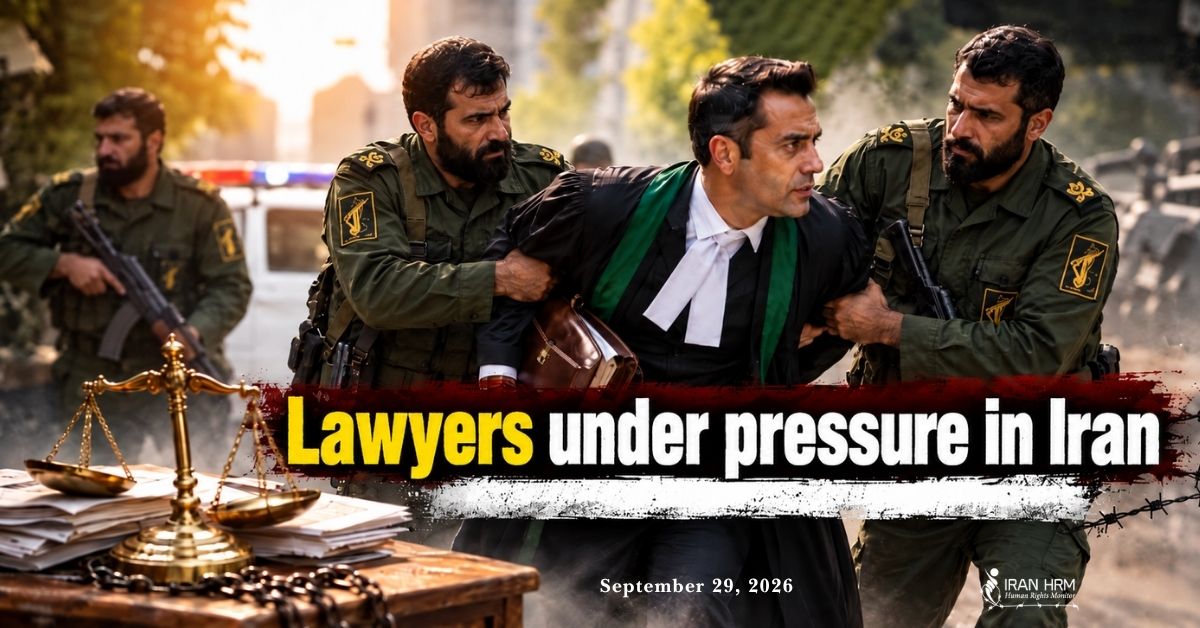
Pressure on independent lawyers in Iran takes various forms: summonses by judicial and security bodies, arrests, criminal proceedings, prison sentences and restrictions on their ability to continue practising. These measures have not affected only lawyers representing political prisoners in court; professional advocacy, enquiries about detainees and comments on judicial proceedings have also led to prosecution in some cases.
The case of Mohammad Najafi, a practising lawyer, shows how far the consequences of pursuing a human rights concern can extend. After investigating the death in custody of Vahid Heydari, he faced multiple criminal cases, years of imprisonment and, ultimately, the permanent revocation of his licence to practise law. Taher Naghavi, who has represented political prisoners, was arrested in January–February 2024 and subsequently sentenced to imprisonment; reports during his detention described his physical condition and a lack of access to medical treatment. In Mohammadreza Faghihi’s case, imprisonment was accompanied by a ban on practising law. He was released on 13 June 2026 after his application for a retrial was accepted.
Collective cases have also been brought against lawyers in Mashhad, Rasht and Shiraz, while the summons of numerous lawyers has been reported in Yazd. Together with individual cases, these developments show that judicial pressure is not confined to one city or a handful of prominent lawyers. The circumstances differ: some lawyers have been arrested, some have received prison sentences, and proceedings involving others remain ongoing.
Concerns about the consequences intensified after the protests of 2025–26. Human rights observers consider that prosecuting a lawyer for representing protesters, enquiring about a client’s situation or speaking about allegations of torture or procedural irregularities can deter other lawyers from taking on sensitive cases.
Selected cases
Gilan lawyers: On 25 September 2026, the convictions of eight lawyers in a joint case before Branch 2 of the Revolutionary Court in Rasht were reported. They are Masoumeh Pourshahrani, Shadi Falahati, Tahereh Pourasmaili, Gholamhossein Layeghi, Mohammad Dalili, Mohammadreza Tak, Hesam Pourahmadi and Ladan Esfahani-Rad. The reported charges were “propaganda against the system” and “insulting the Leader and the founder of the Islamic Republic”. Some had previously been arrested and released on bail.
Zahra Naghshineh: This lawyer and member of the East Azerbaijan Bar Association was arrested on 9 September 2026 after attending Branch 15 of the Prosecutor’s Office in Tabriz. According to published information, her case is connected to her critical writings and statements. The full text of the summons, the charge communicated to her after she attended, and her current situation remain unclear.
Hassan Younesi: On 23 September 2026, this lawyer announced that Branch 26 of the Revolutionary Court in Tehran had sentenced him to one year in prison for “propaganda against the system” and two years for “spreading falsehoods”, imposed a fine of 50 million tomans and restricted his online activity. He linked the case to his statements about the protests of January 2026.
Restrictions on choice of lawyer and effective defence
Pressure on lawyers has a direct consequence for defendants: it limits their ability to choose someone they trust. Under the note to Article 48 of the Code of Criminal Procedure, during the preliminary investigation of certain security and organised crime cases, defendants must choose their lawyer from among those approved by the Head of the Judiciary. This restriction applies when questioning, examination of evidence and decisions about detention are under way.
The legal scope of the note is limited to the preliminary investigation. Nevertheless, there have also been reports of lawyers chosen by families being prevented from participating at the trial stage or accessing case files. Such cases cannot be explained solely by reference to Article 48; the authority responsible for the decision and its legal basis must be examined in each case.
The case of Ehsan Hosseinpour Hesarlou illustrates this concern. His lawyers, Amir Raeesian and Milad Panahipour, said that lawyers chosen by his family were prevented from entering his case before Branch 26 of the Revolutionary Court in Tehran. Ehsan faced the risk of a death sentence, and the two lawyers themselves faced legal proceedings after publicising concerns about his defence. Access to the case file and adequate time to prepare a defence are particularly consequential in such a case.
A lawyer approved by the Judiciary, a court-appointed lawyer and a lawyer chosen by the defendant are distinct categories. This report does not suggest that all lawyers in any one category act in the same way. The question is whether a defendant, particularly one at risk of a death sentence, can in practice choose a lawyer, speak with them confidentially and receive a defence with unhindered access to the case file.
Bar independence and professional pressure
Pressure on lawyers extends beyond criminal cases. The authority of bar associations to assess entry requirements and issue licences is also contested by judicial bodies. In Mazandaran, after reviewing the transcript of an applicant with a level-two seminary qualification, the bar association’s board concluded that the course content was not equivalent to the qualifications required for a legal traineeship. On 7 June 2026, Branch 5 of the High Disciplinary Court of Judges overturned that decision and ordered the association to issue a trainee lawyer’s licence. The ruling bears on an important boundary of professional independence: the bar association is the first body to assess applicants and decide on licences, but the High Disciplinary Court of Judges also has the authority to hear an applicant’s appeal and order the association to issue a licence. The dispute concerned the extent of the bar’s authority to assess the substantive equivalence of seminary education.
In a separate development, Amir Sayyah, Deputy for Economic Affairs and Regulation at the National Centre for Cyberspace, said in response to an online discussion in August–September 2026: “Bar associations should prepare to be dissolved.” His statement was not a legal decision to dissolve them, but it came from a government official and prompted a formal response from the legal profession. The remark was recorded in a report published on 29 August 2026.
Hamedreza Oveysi, a board member of the Qom Bar Association, said that on 31 August 2026 the board approved legal action over Sayyah’s remarks. He asked: “If you believe the bar associations should be dissolved, please explain under which law.” According to Vokala Press, Oveysi described the issue as concerning “the standing and independence of the legal profession”. The concern also relates to the structure of Iran’s judiciary: the Head of the Judiciary is appointed by the Leader of the Islamic Republic, and professional decisions by bar associations are subject to judicial oversight. In critics’ view, any further removal or weakening of independent bar associations would diminish professional support for lawyers who undertake sensitive cases.
Lawyers’ economic and professional situation
Pressure on the legal profession is not solely judicial or security-related. In September 2026, Soleyman Jafari, the managing director of the Lawyers’ Support Fund, said that 17,000 people had applied following one call for loan applications, which he regarded as an indication of financial difficulties among lawyers. This is the number of applications for that particular call; it does not establish how many lawyers are unemployed or how many across the profession face financial hardship.
Jafari also stated that, according to his figures, 45,000 lawyers had entered the profession over approximately 80 years, compared with a further 38,000 since the Iranian year beginning in March 2021. Without separating trainees, licence holders and practising lawyers, these figures cannot establish individual income or employment prospects. They do, however, indicate the scale of change in entry into the profession.
The burden of professional costs is also reflected in a recent decision by the Support Fund. Citing “requests from a number of colleagues” and prevailing conditions, it extended the deadline for paying insurance contributions for the second quarter of the Iranian year 1405 to 22 October 2026. The extension alone cannot establish the scale of financial hardship across the profession, but alongside the volume of loan applications it shows that livelihoods have become a concern for the professional body itself.
Response of judicial officials
On 8 February 2026, Gholamhossein Mohseni Ejei, Head of the Judiciary, said that cases involving people implicated in what he called “riots” and “terrorist acts” during the protests would be addressed “with the utmost speed and care, in accordance with the law and justice”, and that there would be no leniency towards the “main elements”. On 16 February he also called for the issuance of indictments against these individuals to be expedited. These statements show the Judiciary’s emphasis on speed of proceedings and punishment.
On 4 February 2026, Babak Jafari, Vice-President of the Central Bar Association, confirmed the arrest of several lawyers in Tehran and other cities and said that reliable official information about the reasons for their arrests was still unavailable. The Iranian Government also submitted a response on 29 May 2026 to a letter from UN Special Rapporteurs concerning lawyers and detainees’ access to legal counsel. The Head of the Judiciary’s emphasis on swift proceedings leaves questions about the basis for the lawyers’ arrests and guarantees of defendants’ access to counsel at the centre of the issue.
International response and implications for the right to a defence
In a letter dated 24 February 2026, two UN Special Rapporteurs expressed concern about the arrest and prosecution of lawyers and the denial of protesters’ access to lawyers of their choice. Naming Shima Ghoosheh and Nazanin Salari, they asked the Iranian Government to explain the legal basis for the measures taken against them and the steps taken to protect lawyers.
In a post on 26 February 2026, marking the Iranian Bar Association’s Independence Day, Mai Sato, the UN Special Rapporteur on the situation of human rights in Iran, said she had received reports of lawyers being arrested in different provinces following the January protests. She warned that lawyers willing to represent protesters were effectively prevented from doing so in security cases because of the restriction on the choice of lawyer under the note to Article 48. In her assessment, the restriction heightens the risk of torture, forced confessions and proceedings that fall short of international fair trial standards; targeting lawyers also damages civic space.
On 20 February 2026, Amnesty International reported that defendants in some protest-related cases had been denied access to lawyers during investigations and that independent lawyers appointed by their families had not been recognised. According to its findings, in Ehsan Hosseinpour Hesarlou’s case, a judge refused to recognise at least three lawyers chosen by the family and threatened them.
On 2 March 2026, Lawyers for Lawyers, together with 18 other organisations and 180 lawyers, called for an end to reprisals against lawyers in Iran. The signatories emphasised detainees’ right to prompt, confidential access to a lawyer of their choice and the release of lawyers detained for carrying out their professional duties. Pressure on lawyers also restricts their clients’ ability to mount an independent defence.
Conclusion and call for action
Cases involving detained lawyers, restrictions on the choice of counsel and pressure on bar associations together point to a narrowing space for independent defence in Iran. Lawyers are not the only people affected. A defendant denied confidential legal advice in the first days of detention has less opportunity to defend themselves effectively during questioning and judicial proceedings. Where the death penalty is at stake, the consequences may be irreversible.
We call on the United Nations, the Special Rapporteur on the independence of judges and lawyers, the Special Rapporteur on the situation of human rights in the Islamic Republic of Iran, the Independent International Fact-Finding Mission on the Islamic Republic of Iran and international lawyers’ associations to monitor the situation of detained and convicted lawyers. They should seek specific answers from the Iranian Government about the grounds for arrest, charges and detention conditions, and document and publish instances in which chosen lawyers are prevented from participating in protesters’ cases, especially where defendants face the death penalty. They should also call for the release of lawyers detained solely for carrying out their professional duties, an end to their prosecution and access to counsel of choice for all detainees from the outset of investigations.
The right to a defence is meaningful only when a lawyer can act without fear. Protecting independent lawyers in Iran protects every detainee’s right to be heard in a fair trial.