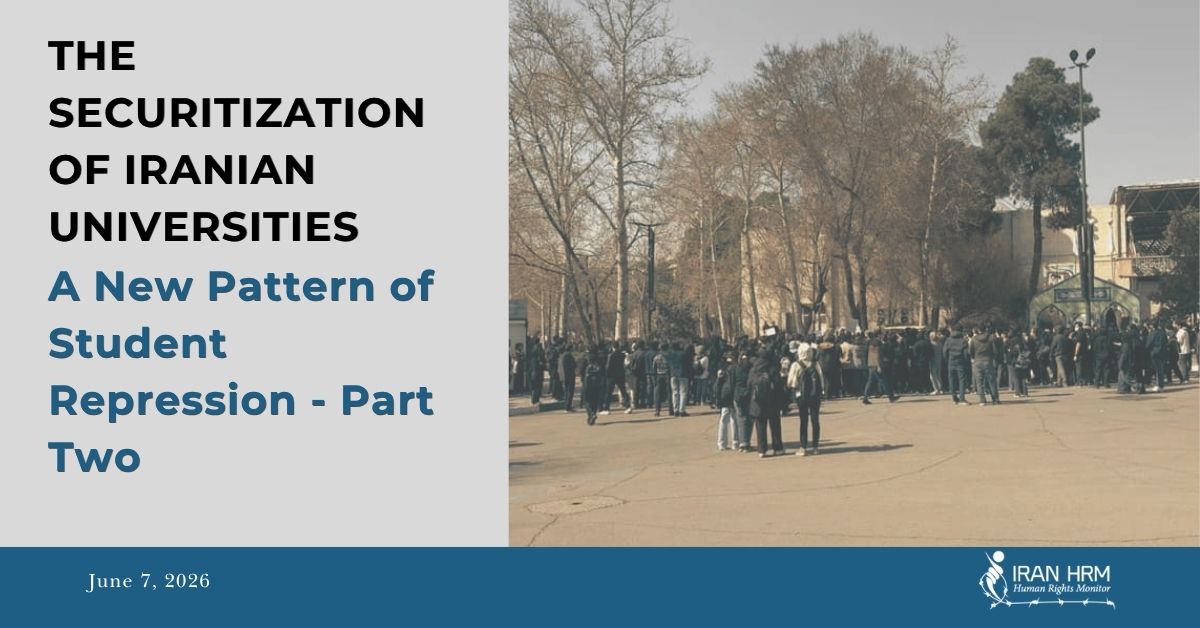
The first part of this report documented cases of arrests, suspensions, expulsions, and disciplinary and security-related prosecutions against students at several major universities in Iran. Available evidence indicates that the latest wave of student repression has not been limited to well-known activists. Hundreds of students across different universities have faced educational restrictions and disciplinary sanctions.

 The significance of this trend, however, lies not only in the number of students targeted. What transforms these cases into a human rights concern is the way they are implemented and the gap between official regulations and the actual practices of university authorities. This section examines disciplinary regulations, documented violations of those regulations, the role of university security offices (Harasat) and security agencies, and the relationship between universities and the judicial system.
What Do Official Regulations Say?
One of the most significant aspects of this issue is the clear discrepancy between the official disciplinary framework and the way universities have implemented it in practice.
According to the official summary issued by the Student Affairs Organization and the published provisions of the disciplinary regulations, the presumption of innocence applies to students. Until a disciplinary ruling becomes final, students are entitled to enjoy all educational rights and privileges. Disciplinary councils are required to avoid personal, political, or factional considerations. Students have the right to defend themselves. The use of evidence obtained through violations of privacy is prohibited. Proceedings must be conducted fairly.
The regulations further specify that only disciplinary councils have the authority to impose disciplinary sanctions. Proceedings must begin with a written complaint or report. A summons must include the nature of the accusation, the reason for the summons, and the time and place of the hearing. Students must be granted at least five days to prepare and present their defense. They must be provided with an opportunity to appear and defend themselves in person. Forced confessions are prohibited. Except in limited circumstances, hearings and disciplinary rulings should not take place during examination periods or immediately before examinations. Any order restricting a student’s access to the university issued by the university president must also be communicated in writing and specify both the commencement and duration of the restriction. Furthermore, according to the text of the regulations, remote or telephone hearings conducted for the purpose of preparing disciplinary records are considered invalid.
These provisions demonstrate that even within the framework of existing domestic regulations, minimum guarantees of disciplinary due process are recognized, including formal notification, awareness of the charges, an opportunity to present a defense, protection against coercion, preservation of educational rights until a final decision is issued, and a prohibition on the use of evidence obtained through violations of privacy.
Violations of the Regulations in Practice
Student reports indicate that many of these principles have been violated in practice.
At the University of Tehran, students were informed by telephone that disciplinary cases had been opened against them. In some instances, they were instructed to submit their initial defense statements via email. Students residing outside Tehran were also reportedly informed of accusations by telephone, without any transparent or formal notification procedure being followed.
At Sharif University of Technology, students reported that in some cases the period between notification of charges and the issuance of disciplinary decisions was extremely short. Some cases reportedly progressed from accusation to final decision within a single day. Reports also described reliance on “informed individuals” and opaque reports, without students being provided with sufficient evidence such as videos, photographs, or documents that could be independently examined. In certain hearings, questioning reportedly extended beyond the subject matter of the case and focused on students’ personal beliefs, political views, and individual opinions.
At Shahid Beheshti University, punitive measures reportedly began even before formal disciplinary procedures had been completed. Educational accounts were blocked, text messages prohibiting campus entry were sent, and students were denied access to educational services before final rulings had been issued. Such actions directly contradict the principle that students retain their educational rights until a disciplinary decision becomes final.
At Iran University of Science and Technology, reports described online and email-based proceedings in more than 100 disciplinary cases. Such practices appear inconsistent with the regulations’ emphasis on in-person defense and their explicit provision that non-presential proceedings lack validity for the preparation of official disciplinary records.
The problem, therefore, is not limited to the issuance of severe sanctions. The more fundamental concern is that the disciplinary process itself appears to have been marked by serious procedural violations, even when measured against the university system’s own regulations.
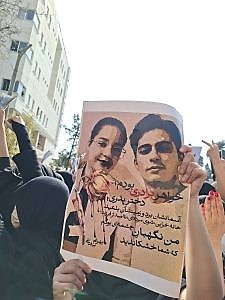 These reported violations include inadequate notification, insufficient time to prepare a defense, punitive measures imposed before final decisions, reliance on information raising privacy concerns, ideological questioning, and psychological pressure on students.
Blocking Educational Systems: Punishment Without a Formal Name
One of the key tools employed during this wave of repression has been the blocking of students’ access to educational systems. This practice has been particularly prominent at Shahid Beheshti University, although indications of similar measures have emerged at other universities as well. While the blocking of educational accounts may appear to be an administrative action, in practice it serves the same function as suspension or deprivation of access to education.
When a student’s access to the university system is blocked, they are unable to register for courses, add or drop classes, view grades, participate in certain examinations, manage academic affairs, or access university services. If such measures are imposed before a final disciplinary ruling is issued, their legal significance is clear: punishment prior to adjudication.
At Shahid Beheshti University, reports indicate that access to the “Beheshtan” educational system was blocked and text messages prohibiting campus entry were sent to students before the completion of formal disciplinary proceedings. This places students in a state of uncertainty. They possess no formal ruling that can be challenged through appeal, yet they are simultaneously deprived of the normal exercise of their educational rights. This situation may be described as a form of “unnamed deprivation” or “silent administrative punishment.”
Such a method is less costly for university authorities than issuing formal disciplinary sanctions. A formal ruling can be appealed, documented, and subjected to review. By contrast, blocking access to educational systems can be presented as an administrative or technical matter while producing the same practical result: exclusion from education.
University Security Offices, Disciplinary Committees, and Revolutionary Courts
Another significant finding is the relationship between university structures and state security and judicial institutions. This connection extends beyond mere allegations.
The disciplinary regulations themselves provide mechanisms through which students may be referred to judicial or law enforcement authorities through disciplinary councils and university legal offices. Judicial proceedings do not prevent the continuation of disciplinary proceedings. The regulations also authorize disciplinary secretariats to respond to judicial requests concerning students’ records.
Senior judicial officials have likewise openly endorsed a hardline approach toward protesters. In January 2026, Gholamhossein Mohseni Ejei, Head of the Judiciary, stated that “there will be no leniency toward rioters” and instructed prosecutors and judicial officials to deal with protesters and their supporters with “decisiveness.” Several weeks later, during discussions with the Minister of Science, he referred to student protests and stated: “If you can manage and address these issues within the university so that they do not reach the Judiciary and no crime occurs, that would be very good.” He further added: “Some of these individuals have committed crimes; this cannot be ignored.”
These statements indicate that, from the perspective of the country’s highest judicial authority, student protests were viewed not merely as university matters but as issues linked to the judicial and security spheres.
This framework alone demonstrates that disciplinary and judicial cases can proceed simultaneously. However, reports from universities suggest an even deeper level of interaction.
At Shahid Beheshti University, one student reported that university security officials informed students that certain directives had originated from the Judiciary. At the University of Tehran, student reports indicate that disciplinary accusations were based on reports prepared by university security offices. At the University of Birjand, the entry of security forces into the university campus and women’s dormitories following the January protests was followed by a subsequent wave of disciplinary sanctions.
The cases of Ali Taheri-Kia, Majid Jamshidzadeh, and Erfan Arabi demonstrate that, for some students, university disciplinary measures and judicial prosecution were not separate processes. Taheri-Kia was convicted by a Revolutionary Court following his arrest. Jamshidzadeh received a five-year prison sentence. Erfan Arabi was sentenced to eight years’ imprisonment. These cases illustrate how pressure may begin within the university environment but ultimately extend to detention facilities and Revolutionary Courts.
Under such circumstances, the university security office (Harasat) functions as more than an administrative protection body. In practice, it can become the first link in a chain involving information gathering, summonses, intimidation, report preparation, and the transfer of students into broader security and judicial mechanisms.
Violations of the Right to Education and Freedom of Expression
From a human rights perspective, this pattern simultaneously affects several fundamental rights.
First, the right to education. Article 13 of the International Covenant on Economic, Social and Cultural Rights recognizes the right to equal access to education. Deprivation of education, suspensions, expulsions, blocking access to educational systems, and restrictions on entering university campuses constitute direct violations of this right when imposed because of the expression of opinions, student advocacy activities, peaceful protest, or online expression.
Second, freedom of expression. Article 19 of the International Covenant on Civil and Political Rights protects every individual’s right to hold opinions and to express them. Restrictions on expression may only be justified under limited, specific, and necessary circumstances. In the cases examined here, however, activity on Telegram, Twitter, private groups, the signing of statements, participation in student protests, and even profile photographs have become the basis for disciplinary or security-related accusations. Such measures are incompatible with the principles of necessity and proportionality that govern restrictions on freedom of expression.
Third, the right to due process. Although a disciplinary committee is not a judicial court, when its decisions can result in suspension, expulsion, or deprivation of access to education, basic guarantees of fair process must be respected. These guarantees include transparent notification of charges, access to relevant evidence, adequate time to prepare a defense, protection against coercion, impartial proceedings, and access to meaningful avenues of appeal. Available reports indicate that these rights have been violated in numerous cases.
Fourth, university autonomy. Universities should serve as spaces for education, research, dialogue, and critical inquiry. When university security offices, disciplinary committees, security agencies, and Revolutionary Courts operate along a common path to regulate and control students, institutional autonomy is undermined. The university ceases to function solely as an academic environment and instead becomes part of a broader system of political and social control.
Human and Social Consequences
The consequences of these policies extend far beyond statistics and case files.
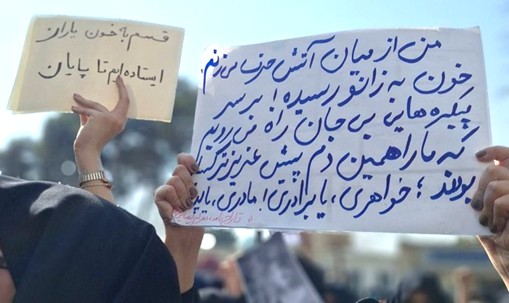 Every suspension blocked educational account, arrest, or security-related prosecution affects a student’s academic and professional future. A two-semester suspension or expulsion can disrupt years of academic effort. The denial of welfare and student support services can make continued education difficult or impossible for students who have relocated from other cities. Arrests and security-related prosecutions also impose significant psychological and emotional burdens on students and their families.
For the broader academic community, the result is the expansion of self-censorship. When students observe that a message in a private group, a repost on social media, or even a profile photograph can lead to disciplinary proceedings or expulsion, many are likely to withdraw from expressing opinions, participating in student activities, or engaging in academic and public discussions.
This environment also contributes to the growing emigration of talented students and researchers. When students at institutions such as Sharif University of Technology, the University of Tehran, and Iran University of Science and Technology perceive that their academic future may be jeopardized because of civic engagement or the expression of personal views, emigration increasingly becomes not merely a choice but a means of escape. In the long term, the costs of these policies are borne not only by the targeted students but by the country’s entire academic and scientific community.
Conclusion
The wave of measures taken against students during 2025 and 2026 is not simply a collection of disciplinary rulings or isolated arrests. Available evidence indicates that at several major universities, including the University of Tehran, Iran University of Science and Technology, Sharif University of Technology, Shahid Beheshti University, and the University of Birjand, educational and disciplinary mechanisms have been employed as tools for controlling students.
Within this framework, student advocacy activities, participation in protests, the expression of opinions on social media, messages exchanged in private groups, and even profile photographs can become grounds for disciplinary proceedings. Educational systems may be blocked before final decisions are issued. Students may be summoned by telephone, required to defend themselves without adequate access to evidence, and simultaneously face the risk of arrest or referral to Revolutionary Courts.
Even under the universities’ own official regulations, many of these practices raise serious concerns. The presumption of innocence, the right to defense, formal notification, adequate time to prepare a response, the preservation of educational rights until a final ruling is issued, and the prohibition on the use of evidence obtained through violations of privacy are all explicitly recognized in existing regulations. Yet student testimonies indicate that these principles have repeatedly been disregarded in practice.
The central issue, therefore, is not merely the repression of a limited number of students. Rather, it is the transformation of the university into a securitized environment; one in which educational structures, disciplinary mechanisms, university security offices, and judicial institutions can operate together to regulate students’ behavior, expression, and future prospects. This process simultaneously threatens the right to education, freedom of expression, university autonomy, and the personal security of students.